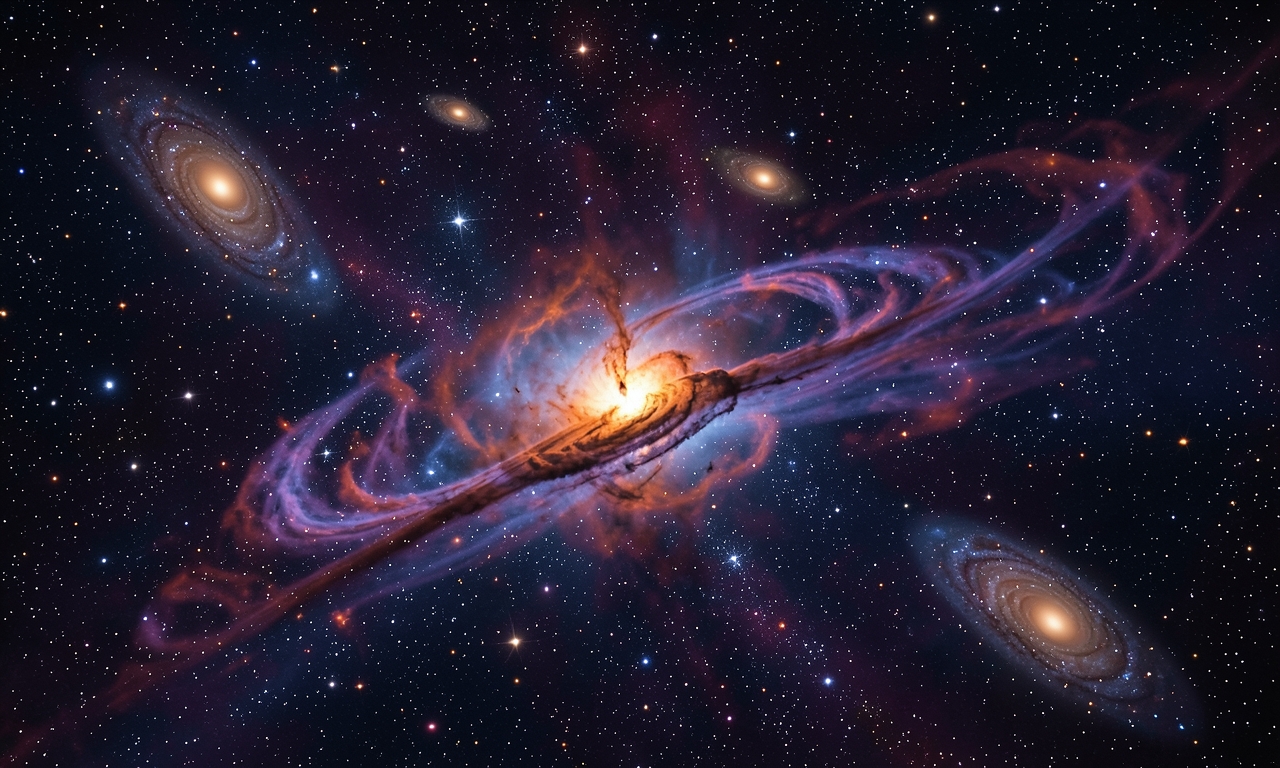
New Measurements Reveal Massive Energy Output
An international team of researchers analyzed data indicating that the winds streaming from supermassive black holes carry up to a hundred times more energy than earlier estimates suggested. The study relied on X‑ray and radio observations that tracked the motion of hot gas around these objects.
The results show that the kinetic energy of these flows is sufficient to accelerate material to distances of about 300,000 light‑years. Consequently, their impact extends well beyond the host galaxies where the black holes reside.
Such a reach implies that the winds can substantially heat and reshape the intergalactic medium. This, in turn, may suppress or stimulate star formation in neighboring galaxies, depending on local conditions.
The scientists emphasize that previous models underestimated the effect of these outflows. The revised numbers force a reassessment of galaxy evolution and the feedback loop between central black holes and their surroundings.
Future observations with upcoming observatories will test whether similar phenomena occur around less massive black holes and how they shape the cosmic web on the largest scales.