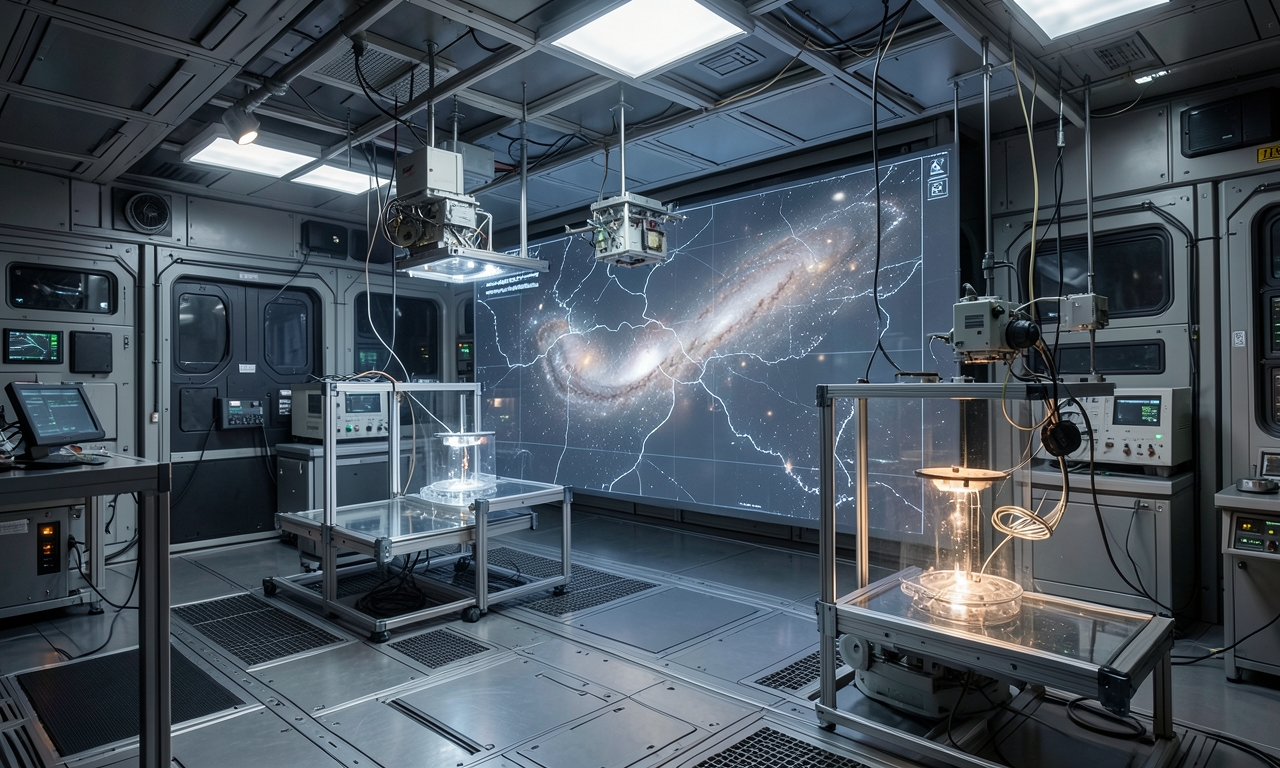
Findings from an extensive galaxy survey
The Dark Energy Spectroscopic Instrument (DESI) completed a survey earlier this year, mapping 47 million galaxies out to roughly 11 billion light‑years. This unprecedented dataset provides a detailed view of the large‑scale distribution of visible matter.
Testing cosmic isotropy
Astronomers Francesco Sylos Labini and Marco Galoppo examined the data to assess whether the universe is isotropic on the biggest scales – that is, whether its structure appears identical in all directions. Their statistical analysis indicates notable directional variations.
Implications for cosmology
The results, published in Nature, contradict a core premise of the standard cosmological model, which assumes homogeneity and isotropy of space‑time. If confirmed, these findings could prompt a reassessment of theories concerning cosmic expansion and dark energy.
Need for further investigation
The authors stress that additional observations and independent analyses are required to verify the robustness of the claim. Upcoming surveys, such as those from the Vera C. Rubin Observatory, may help rule out systematic biases and further map the universe’s structure.