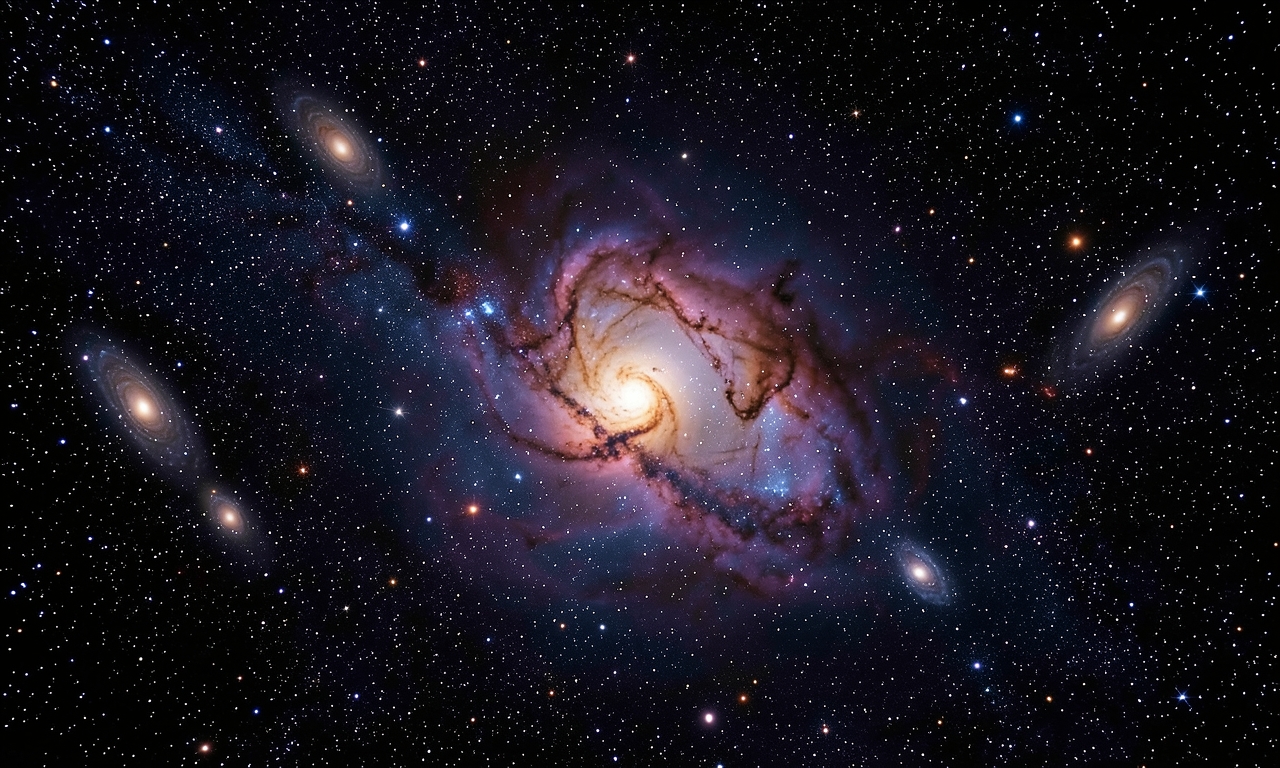
Record‑breaking radio detection
An international team operating the MeerKAT array in South Africa has reported the discovery of the most distant hydroxyl megamaser known to date. The natural space laser, produced by excited hydroxyl (OH) molecules, was found in a violently merging galaxy whose light has travelled more than 8 billion years to reach Earth.
Hydroxyl megamasers arise when dense molecular clouds are pumped by intense infrared radiation, causing the OH molecules to emit coherent radio waves that can be millions of times brighter than typical astrophysical masers. Their extreme luminosity makes them valuable probes of the physical conditions in distant galaxies.
The detection provides a new tool for studying star‑formation activity and gas dynamics in the early universe. Because megamasers trace massive starbursts and galaxy collisions, they can be used to infer rotation curves, gas densities, and the energetics of merging systems at cosmological distances.
- Enables measurement of the host galaxy’s rotation speed
- Offers estimates of central gas temperature and density
- Illuminates the role of mergers in early galaxy evolution
The finding results from a larger survey aimed at cataloguing rare, high‑luminosity radio sources in the distant cosmos. Detailed analysis will be submitted to a peer‑reviewed astrophysics journal later this year.