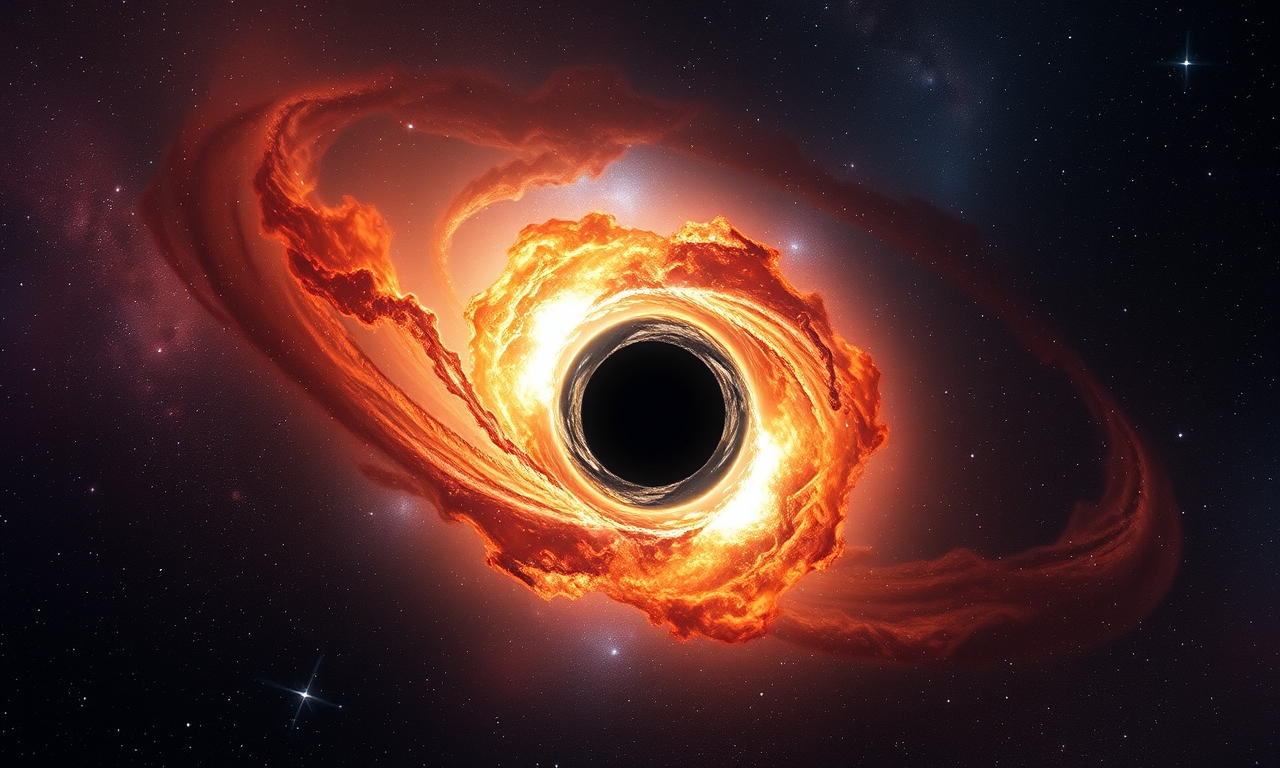
Discovery of an Unusual Tidal Disruption Event
A group of astronomers has examined the tidal disruption event designated AT2024tvd, in which a star was torn apart by a supermassive black hole. The event’s location is significantly offset from the center of any visible galaxy, indicating the presence of a wandering black hole.
Observational Approach
The study combined several weeks of optical and ultraviolet monitoring with spectroscopic analysis to determine the velocity and composition of the ejected debris. The light curve displayed a rapid rise followed by a gradual decline, characteristic of TDEs, but with an unusually large spatial displacement from the nearest galactic nucleus.
Interpretation of Findings
Researchers conclude that the disrupting black hole is no longer bound to the core of its original host galaxy. Such wandering supermassive black holes can be ejected by galaxy mergers or gravitational interactions, losing their surrounding stellar population while retaining enough mass to capture and destroy stars.
Implications for Astrophysics
This observation provides direct evidence that supermassive black holes do not always reside at galactic centers. It opens new avenues for studying galaxy evolution, black‑hole dynamics, and the frequency of off‑center tidal disruption events.
Publication
The findings were published on June 12 in The Astrophysical Journal Letters.