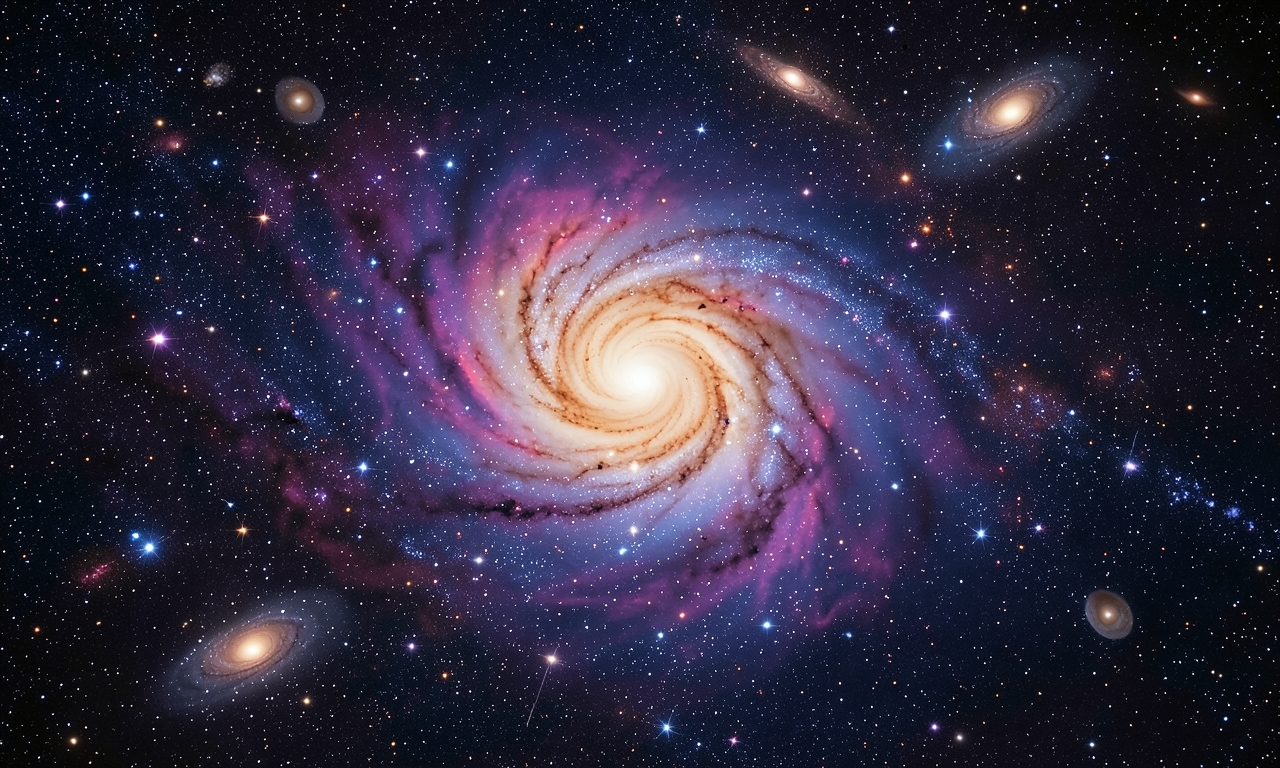
The Hubble Space Telescope captured NGC 4698, a spiral galaxy located roughly 55 million light‑years away in the constellation Virgo. As a member of the Virgo Cluster, the nearest large gathering of galaxies bound by gravity, it displays the classic features of a spiral: a flat disk of stars, gas and dust, winding spiral arms and a bright central bulge.
The bulge glows with the light of older, cooler stars, while a supermassive black hole containing millions of solar masses is thought to reside at its centre, actively pulling in surrounding material. Despite these familiar traits, NGC 4698 exhibits behaviour that sets it apart from typical spirals.
Possible Causes and Ongoing Research
The bulge of NGC 4698 extends outward from the disk at a right angle, a rare configuration among spiral galaxies. Even more striking, the stars and gas nearest the centre rotate in a direction perpendicular to the rest of the disk – they move counter to the galaxy’s overall spin. Scientists suggest that external influences may have produced this misalignment.
One scenario involves the capture of gas from outside the galaxy. If such inflow occurred, the newly acquired material could have formed a misaligned inner disk of stars and gas. Supporting this idea, observations reveal a faint tail of hydrogen streaming from one side of NGC 4698, indicative of a past minor merger with a smaller companion. Such an encounter could have delivered gas at an angle, leading to the present‑day orthogonal rotation.
The imaging data were obtained under Hubble program #18103, led by researcher Thilker, which focuses on galaxies within the Virgo Cluster. Studying NGC 4698 helps astronomers learn how interactions with the surrounding environment can reshape the internal dynamics of galaxies over time.