Rare cosmic collision uncovered
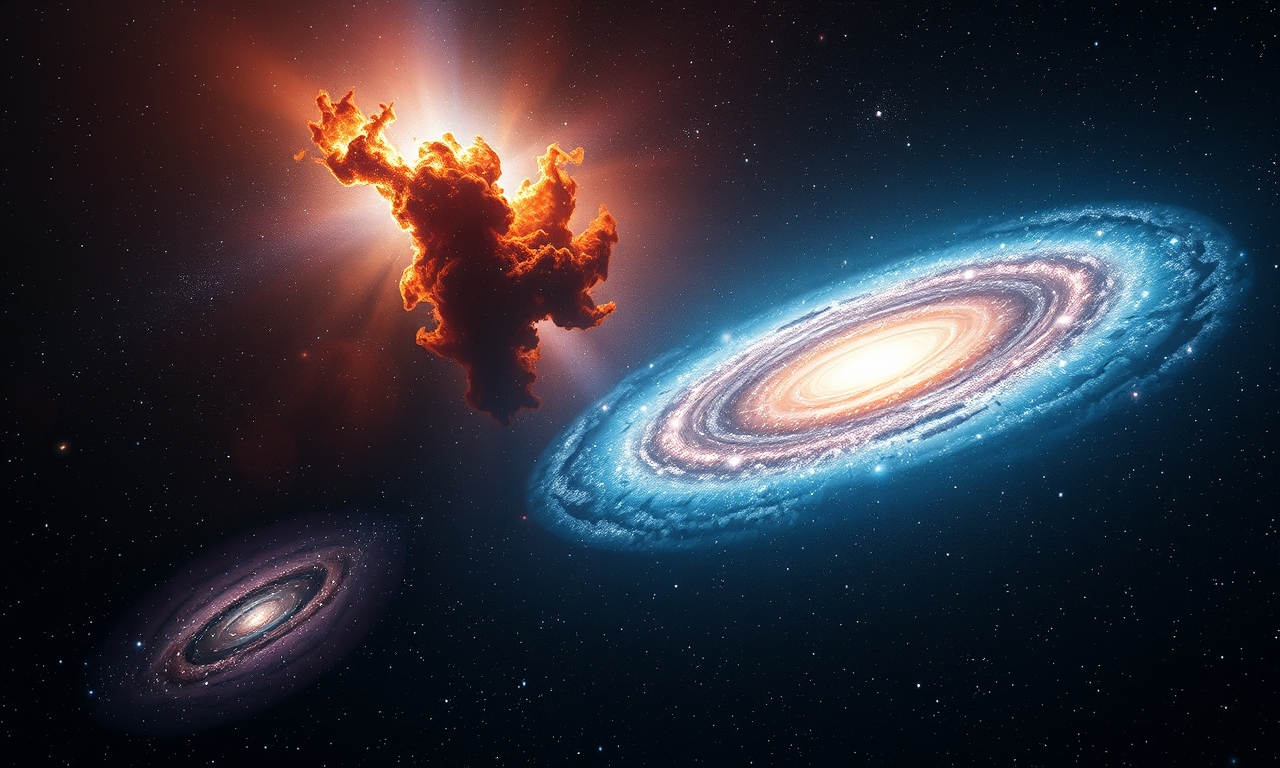
An international research group has documented an extraordinary galaxy merger involving six supermassive galaxies colliding at the same time. The findings were presented in a preprint posted on arXiv and illustrate the immense scales involved in cosmic structures.
Observation details
The study utilizes high‑resolution data from several space‑based observatories to map the spatial distribution and dynamics of the interacting galaxies. Each galaxy hosts a central supermassive black‑hole region, whose mutual influence generates intense radiation and matter flows.
Implications for astrophysics
Such mega‑mergers are exceedingly rare because the probability of six massive galaxies converging within a relatively small volume is extremely low. The event provides a unique laboratory for testing galaxy‑evolution models and the role of supermassive black holes in highly gravitating environments.
Future research
The authors, led by Z.L. Wen of the Chinese Academy of Sciences, intend to conduct detailed simulations to predict the system’s long‑term evolution. Results may reveal how common these mega‑mergers were in the early universe and their impact on large‑scale cosmic structure.