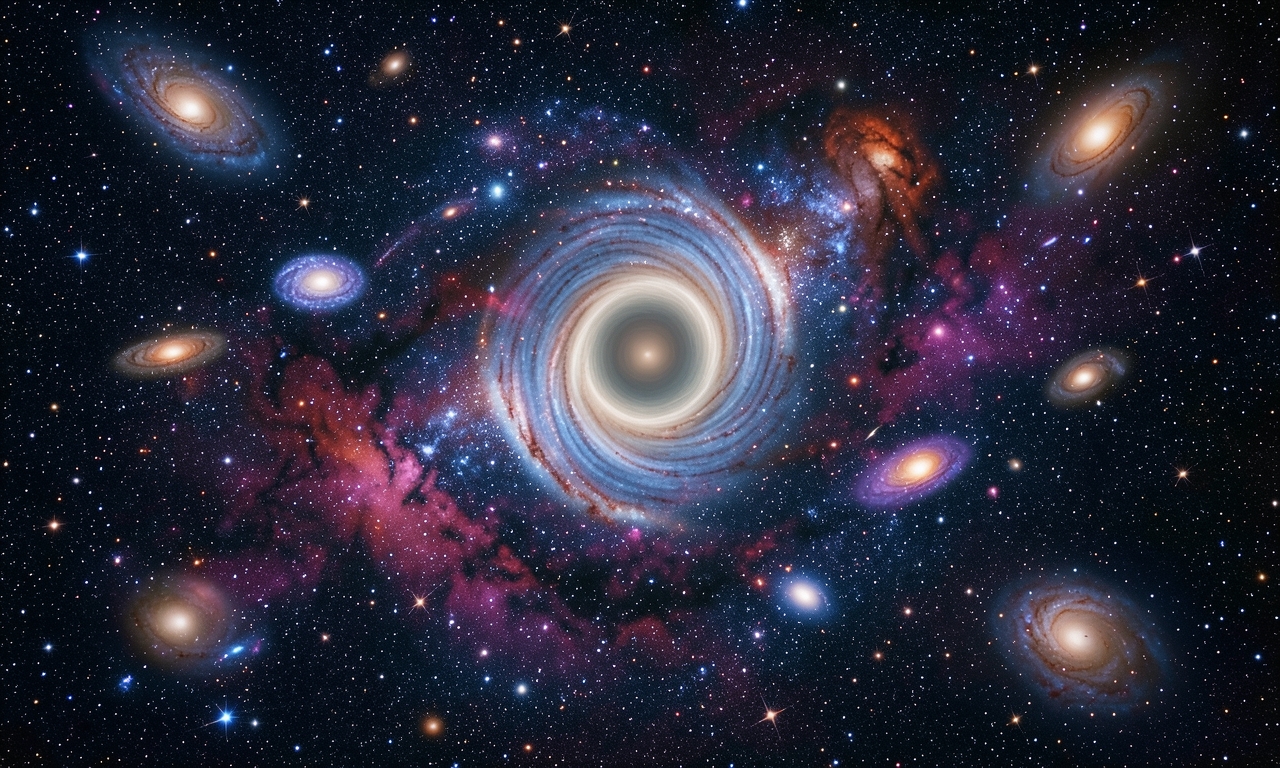
New interpretation of a striking ring pattern
Two researchers from the University of Florida have presented a model in the Astrophysical Journal suggesting that the nine almost perfect rings encircling the so‑called Bullseye galaxy (LEDA 1313424) are not the remnants of a galactic encounter but the result of quantum behavior of dark‑matter particles.
Axion condensate as the driver
According to Pierre Sikivie and Yuxin Zhao, a Bose‑Einstein condensate composed of axions—hypothetical particles considered a leading dark‑matter candidate—could generate the observed wave‑like structure. In such a state the particles act as a single macroscopic wave, spreading uniformly around the galaxy’s center and producing the concentric shells.
Contrast with earlier scenarios
Previous explanations invoked gravitational disturbances caused by a collision with another galaxy. The new hypothesis challenges that view, arguing that the spacing and symmetry of the rings align more closely with predictions for an axion condensate.
Implications for dark‑matter research
If confirmed, the Bullseye galaxy would provide a rare astrophysical example of macroscopic quantum effects and could serve as indirect evidence for axions. High‑resolution observations and detailed simulations are required to test the model further.
Future directions
The work opens a pathway to probe dark matter not only through its gravitational imprint but also via possible collective quantum states. Astronomers intend to search for similar ring formations in other galaxies to assess the broader relevance of the phenomenon.