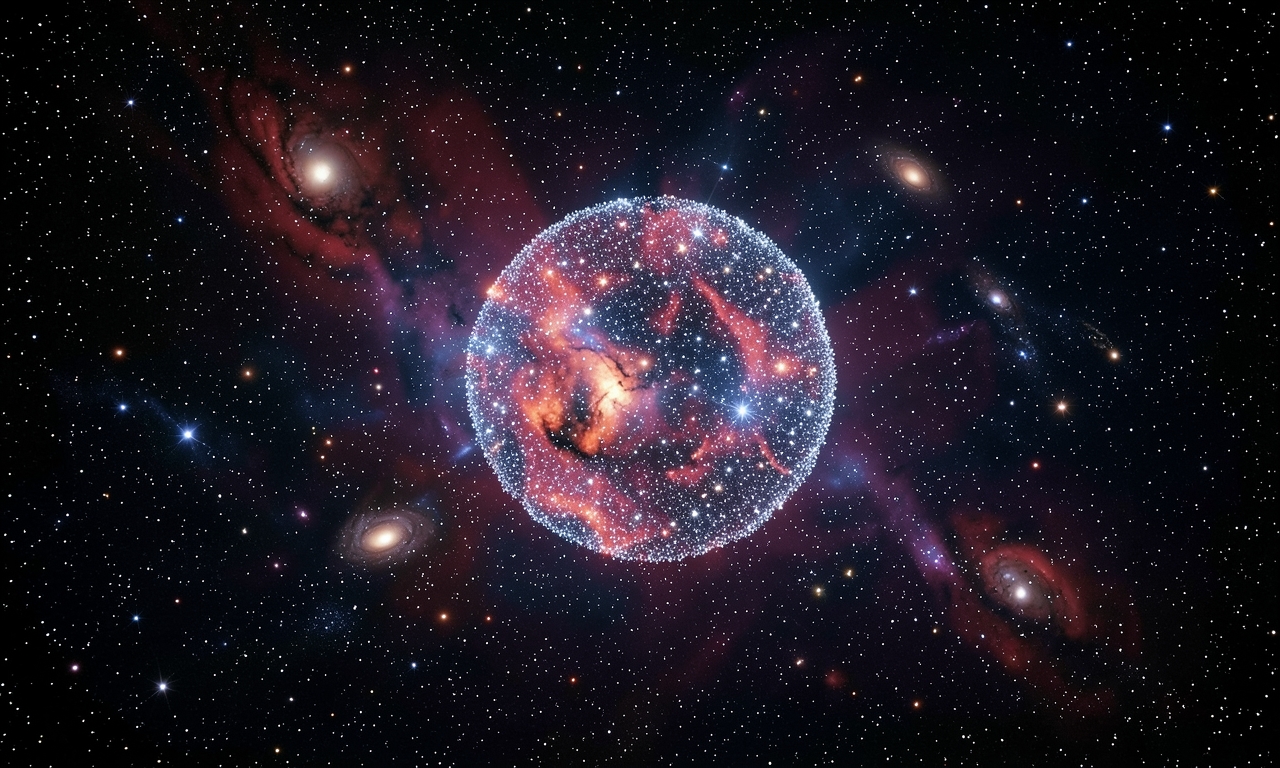
A Sparkling Celestial Chandelier
On June 26 2026 a high‑resolution image of the globular cluster NGC 6723 was released, revealing a dense assembly of stars that resembles a grand chandelier. Located in the constellation Sagittarius, the cluster lies roughly 27,000 light‑years from Earth.
One of the Milky Way’s Ancient Stellar Populations
Globular clusters are among the oldest components of the Milky Way, and NGC 6723 hosts stars that formed more than ten billion years ago. The sheer number of luminous points creates a striking visual effect, making the cluster a natural laboratory for studying early galactic evolution.
Observational Characteristics and Scientific Value
NGC 6723 is accessible to mid‑size telescopes, with its bright core standing out against the surrounding sky. Researchers analyze such clusters to determine stellar ages, metallicities, and dynamical histories, which in turn illuminate the formation processes of the Galaxy’s halo.
Future Research Directions
Upcoming observations with space‑based observatories and high‑resolution spectroscopy aim to map the detailed properties of individual stars within NGC 6723. These studies will refine models of the Milky Way’s early development and clarify the role globular clusters play in the broader cosmic context.