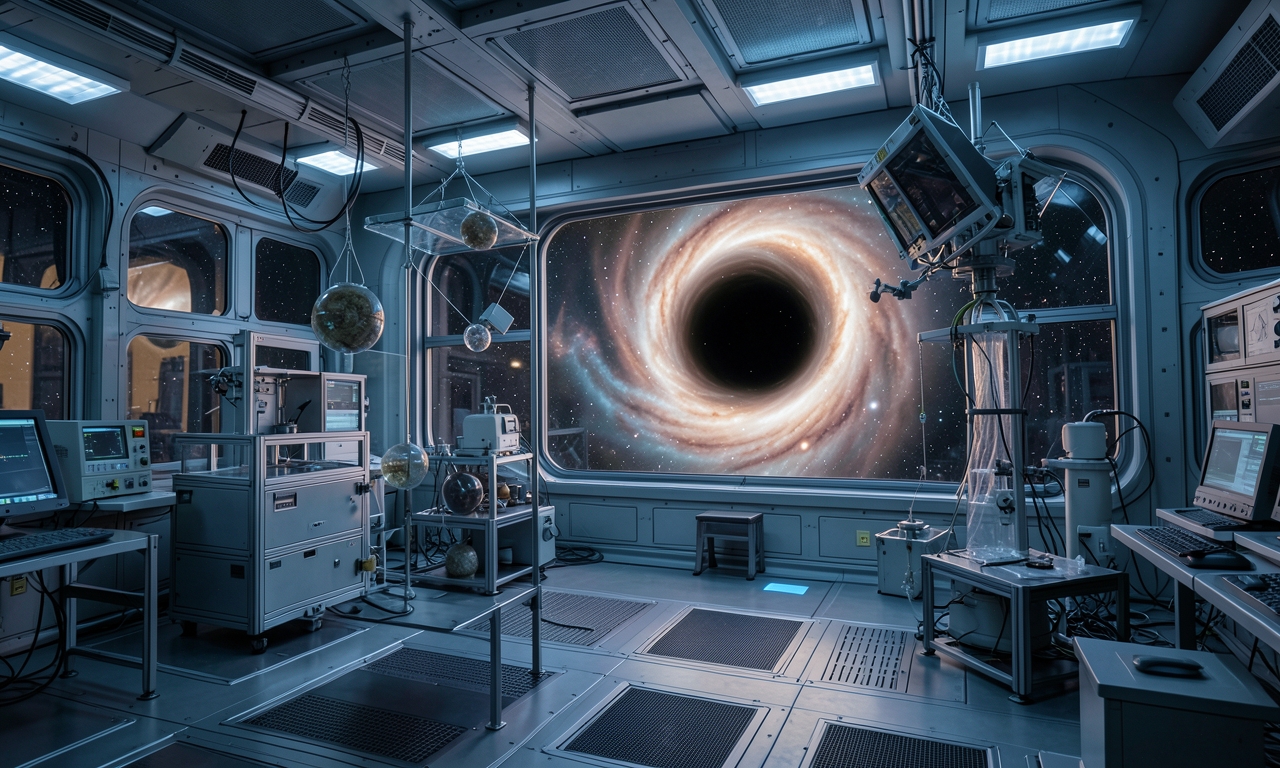
An extraordinary black hole in our cosmic backyard
Located at the core of a relatively close galaxy, a rapidly feeding black hole has been identified. Observations reveal that its accretion rate and associated radiation closely resemble those expected from the first supermassive black holes that appeared in the early universe.
Shared traits with primordial cosmic titans
The measured properties—particularly the high Eddington ratio and strong X‑ray and infrared emission—match theoretical predictions for the massive black holes that formed only a few hundred million years after the Big Bang. These similarities allow researchers to probe the physics of that epoch indirectly.
Implications for cosmology
Because the object resides in a well‑studied galaxy, data from multiple observatories can be combined at high resolution. The findings help address lingering questions about the rapid growth phase of black holes and the co‑evolution of early galaxies.
Future prospects
Upcoming observations with the James Webb Space Telescope and next‑generation radio arrays aim to resolve the details of the accretion mechanisms and to determine whether this black hole truly serves as a local analogue of the primordial giants.