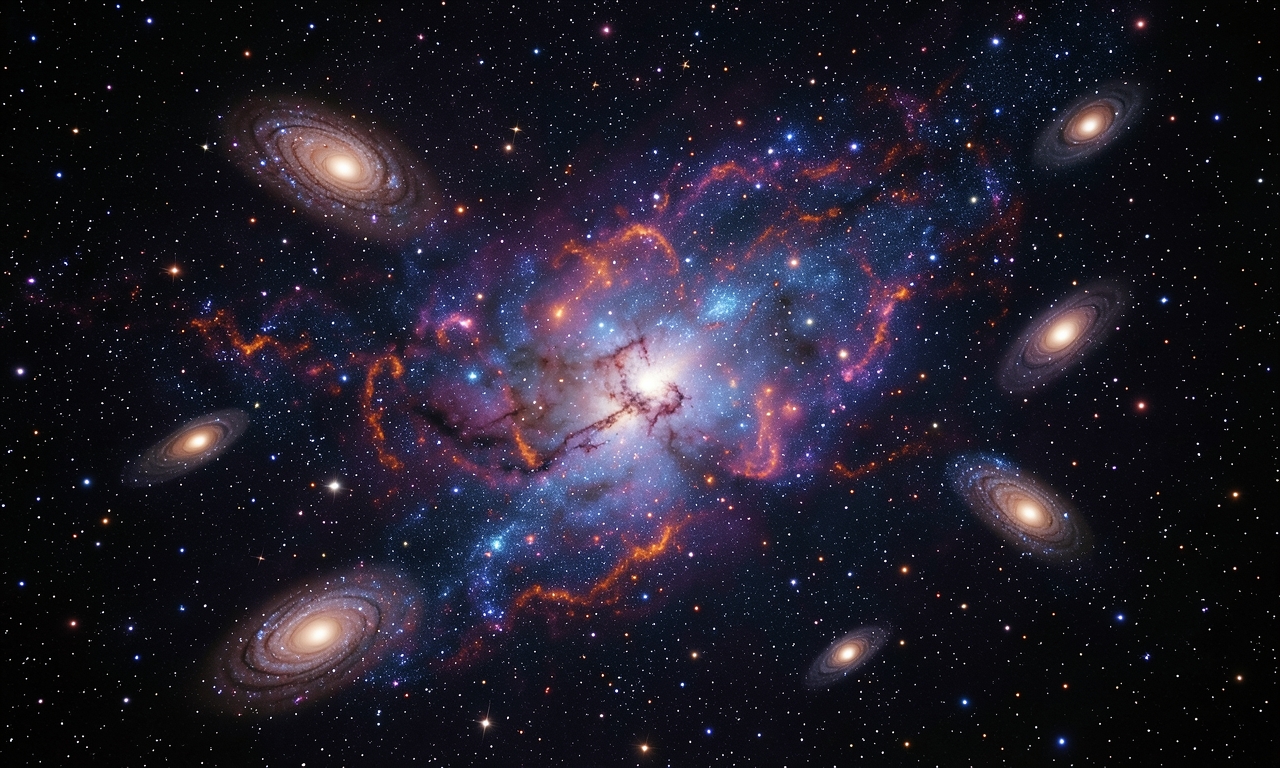
During the first billion years after the Big Bang, the cosmos was enveloped by a thick veil of neutral hydrogen that absorbed virtually all light. Researchers have long sought the agent that later cleared this fog, allowing the universe to become visible.
Discovery of an energetic galaxy
Using the Hubble Space Telescope, scientists identified a small yet extremely luminous galaxy existing roughly 1.4 billion years after the Big Bang. The galaxy exhibits intense star‑formation activity, releasing vast amounts of energy.
Mechanism of fog removal
The radiation and galactic winds generated by massive stellar explosions appear to ionize and push away the surrounding hydrogen gas. This process would effectively dissolve the opaque veil, rendering the universe transparent for subsequent structure formation.
Implications for cosmic reionisation
The observation provides a potential "smoking gun" for the long‑sought reionisation epoch, marking the transition from the cosmic dark ages to a light‑filled universe. Confirmation from additional similar galaxies could refine our understanding of early cosmic evolution.
Future prospects
Upcoming observatories, notably the James Webb Space Telescope, will have the sensitivity to probe even fainter and more distant objects. These capabilities will test whether the galaxy observed by Hubble is representative of the primary sources that drove early reionisation.