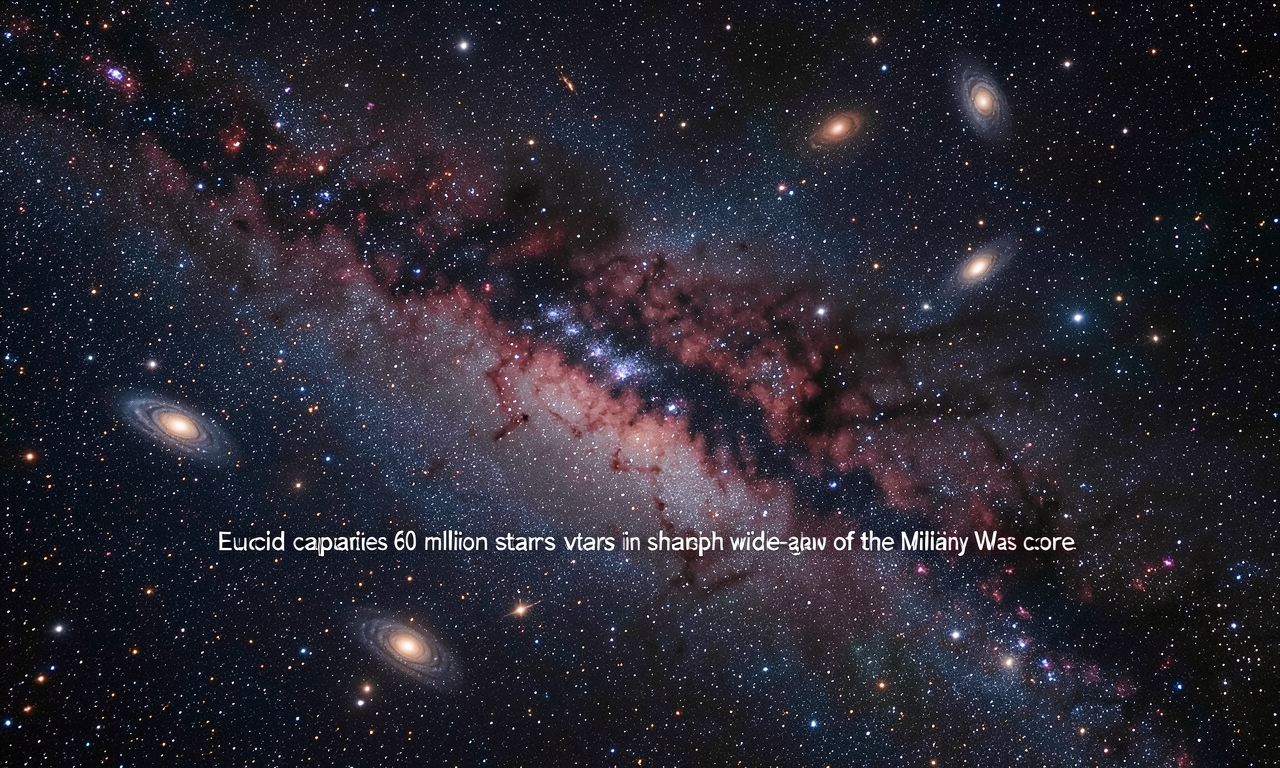
Euclid captures 60 million stars in sharpest wide‑angle view of Milky Way’s core
The Euclid space telescope devoted one day to staring at the bright inner region of the Milky Way, known as the galactic bulge. This brief but focused look was requested by astronomers eager to exploit Euclid’s strength in imaging large sky areas with high resolution.
Despite the short duration, Euclid’s wide field of view and sharp optics allowed it to detect roughly sixty million individual stars. The resulting image reveals the stellar crowding in the galaxy’s centre with a level of detail not previously achieved in such wide‑angle surveys.
Researchers anticipate that the data will shed light on the age, composition and motions of stars within the bulge, improving our understanding of how the Milky Way’s central region formed and evolved over time.
The observation proposal came from a team of scientists who wanted to use Euclid’s survey capabilities to map extensive portions of the sky. They regard the new dataset as a valuable foundation for further work on galactic dynamics and the distribution of dark matter in the inner galaxy.
Although Euclid’s primary mission concerns dark energy and the large‑scale cosmic web, this demonstration shows that the observatory is also exceptionally well suited for detailed studies of our own galaxy’s structure.