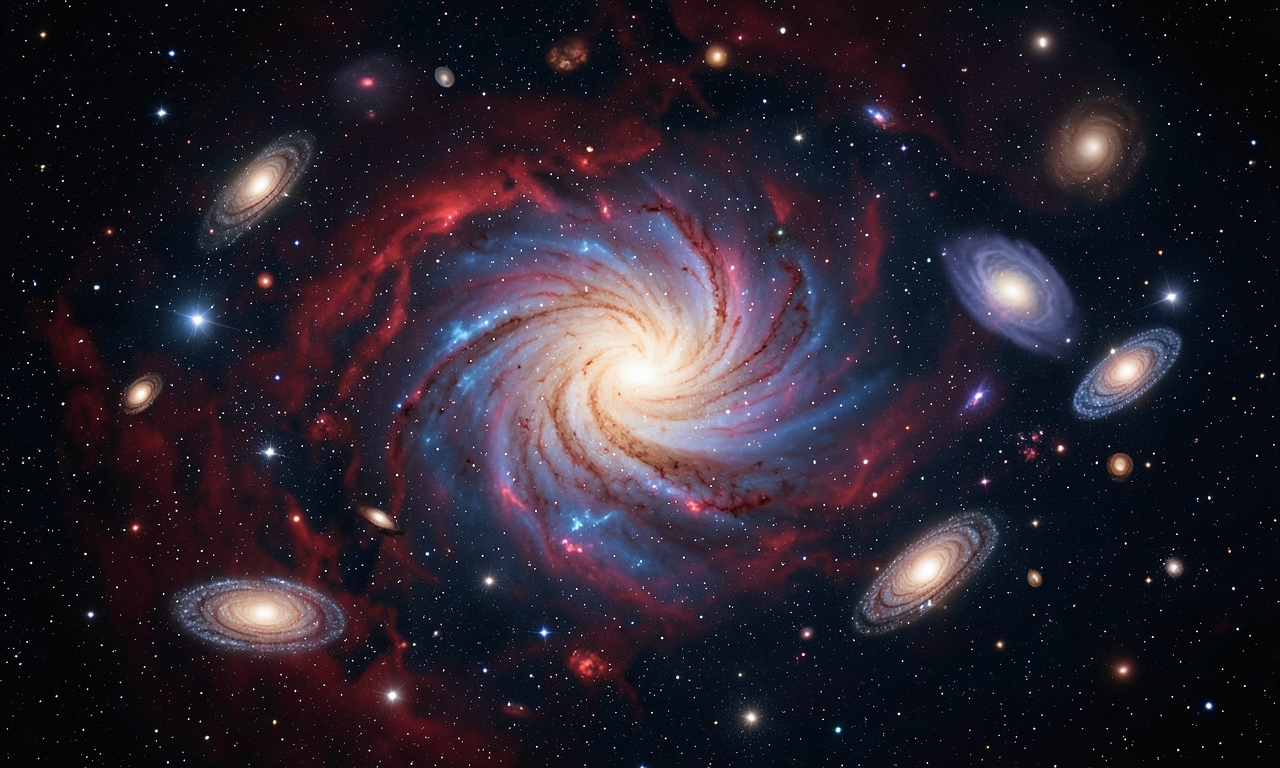
Discovery of Starless Hydrogen Clouds Near the Whirlpool Galaxy
An international team of astronomers employed China’s 500‑meter FAST radio telescope to map the 21‑cm line emission of neutral hydrogen around the spiral galaxy M51, popularly known as the Whirlpool Galaxy. The survey revealed two extensive, coherent structures extending several arcminutes beyond the galaxy’s bright optical disk.
Each cloud contains roughly three million solar masses of atomic hydrogen, with no significant contribution from helium or heavier elements detected. The inferred column densities place the clouds in a regime where, according to standard models, a fraction of the gas should be molecular and capable of forming stars.
Extensive searches in optical imaging from the Sloan Digital Sky Survey and archival Hubble Space Telescope data yielded no detectable stars, star clusters, or Hα emission. Even when pushing the analysis to surface‑brightness limits of a few percent of the expected stellar light, no counterpart emerged.
The absence of an optical signature makes these objects prime candidates for the so‑called “dark gas” phase predicted in cosmological simulations but rarely observed directly. Such reservoirs could represent accreted intergalactic material awaiting conversion into stars, or they may trace earlier phases of gas cooling and fragmentation.
The findings appear in the journal Astronomy & Astrophysics and highlight FAST’s power to uncover faint, diffuse hydrogen structures in the outskirts of galaxies. Follow‑up observations with interferometric arrays such as the VLA and ALMA are planned to probe the clouds’ internal velocity fields, possible molecular fractions, and their interaction with the surrounding galactic environment.