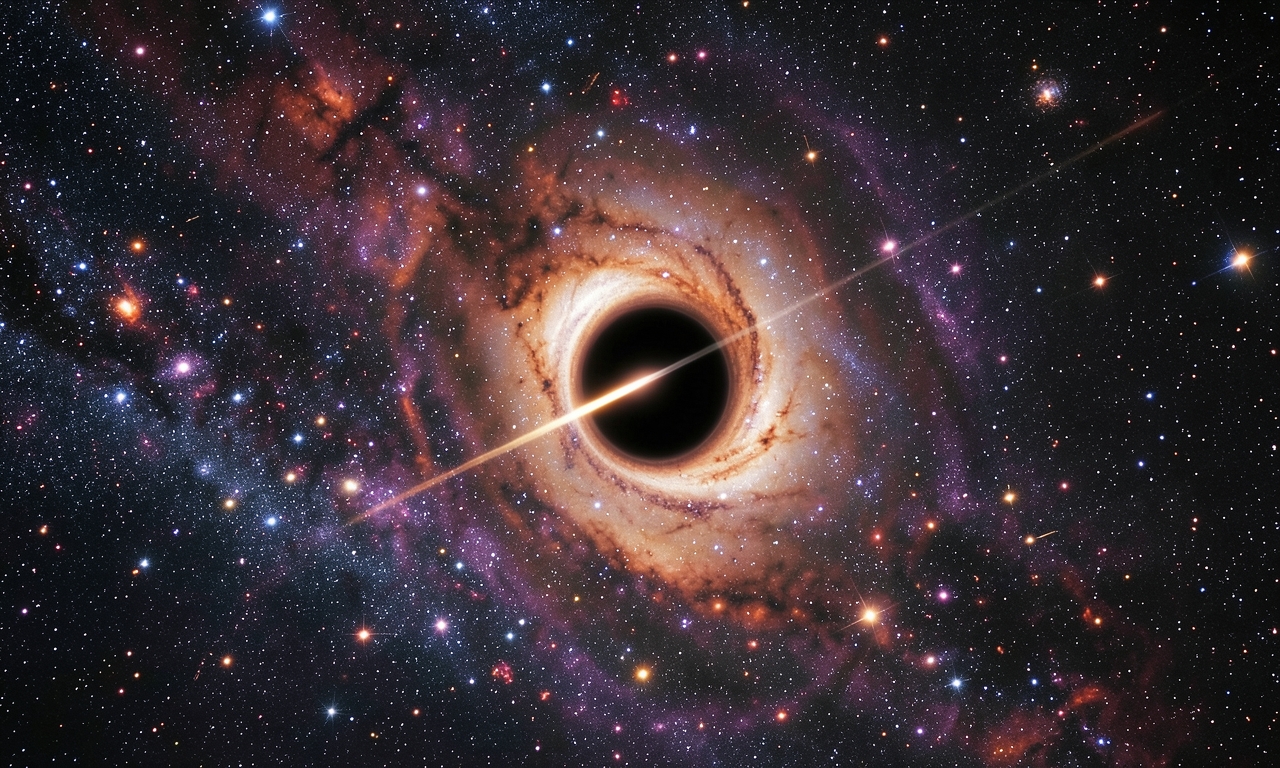
Using the European Southern Observatory's Very Large Telescope Interferometer (VLTI), astronomers have identified the fastest known star orbiting the Milky Way’s central black hole. The star, designated S301, travels at roughly 25 000 km/s and passes closer to the black hole than any previously observed star.
At this proximity, the star’s motion is influenced not only by the black hole’s mass but also by its rotation. The relativistic frame‑dragging effect, also called the Lense‑Thirring effect, causes subtle shifts in S301’s orbit that can be measured with high‑precision interferometry.
By comparing the observed trajectory with a pure Keplerian model, researchers can infer the spin of the four‑million‑solar‑mass black hole. This provides a direct test of general relativity in the strong‑gravity regime near a rotating supermassive object.
Future observations with the VLTI and upcoming facilities such as the Extremely Large Telescope aim to refine these measurements, improving our knowledge of black hole spin and the dynamics of galactic nuclei.