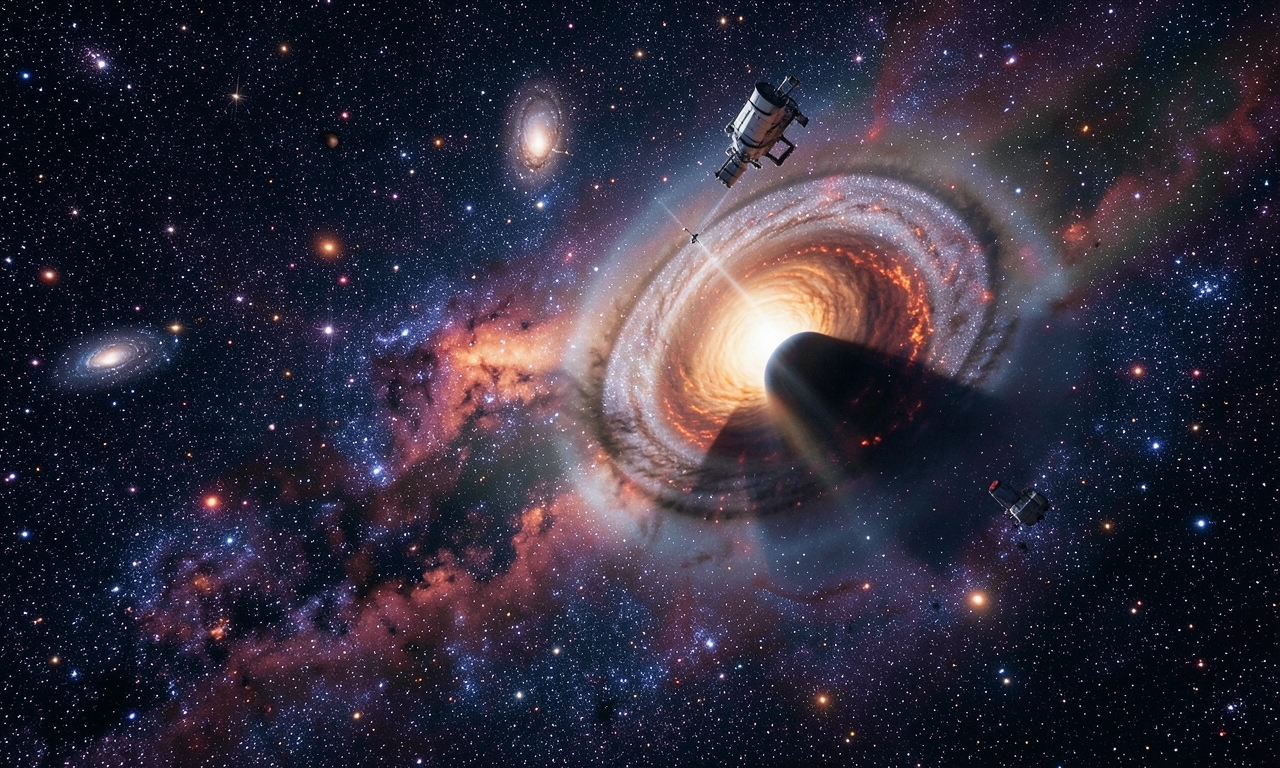
Gravitational-wave astronomy has opened a new observational channel for studying the most violent processes in the cosmos, such as the merger of black holes.
Signal Analysis
An international collaboration, including two researchers from Australia, examined the loudest gravitational-wave event detected so far. The signal originates from the inspiral and merger of two black holes and exhibits an unusually high signal‑to‑noise ratio, allowing a detailed reconstruction of its waveform.
Results and Interpretation
By comparing the measured waveform with theoretical templates, the team identified features that appear just before the horizons of the two black holes come into contact. This provides the first direct insight into the region surrounding the event horizon during the merger.
The observed characteristics agree with predictions from general relativity, confirming that the strong spacetime curvature near the horizon leaves an imprint on the gravitational-wave signal that can be measured with current detectors.