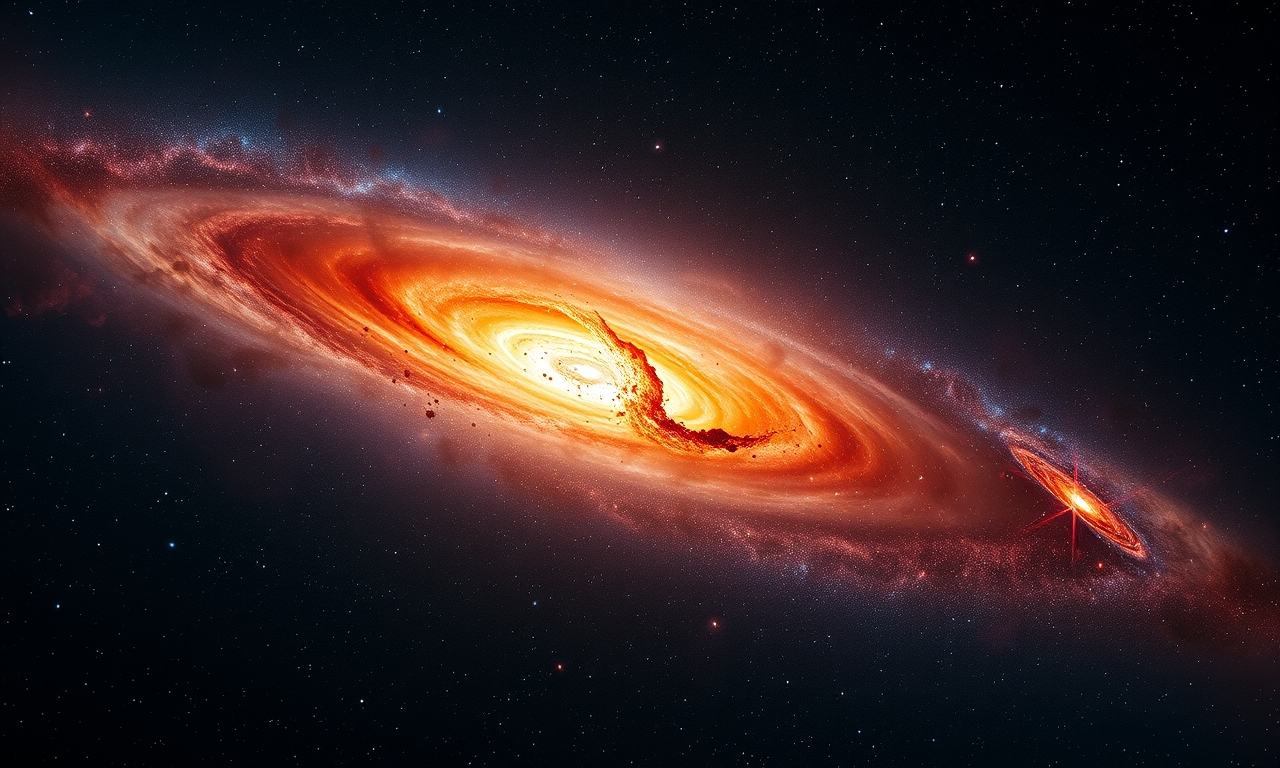
A rare glimpse of a cosmic collision
The Hubble Space Telescope has obtained an image of an exceptionally luminous galaxy cluster, identified as CL0016+1609 or MACS J0018.5+1626. This system ranks among the most thoroughly examined clusters in both X‑ray and radio wavelengths.
X‑ray observations expose the true structure
Data collected in the X‑ray band reveal that the apparent single object consists of two distinct galaxy clusters moving toward each other along our line of sight. This alignment offers astronomers a unique perspective on the dynamics of cluster mergers.
Implications for astrophysics
Cluster collisions are fundamental to understanding the large‑scale evolution of the Universe. By mapping temperature variations and gas densities in the X‑ray regime, researchers can infer the physical conditions prevailing during the merger.
Future investigations
Planned follow‑up observations with high‑resolution X‑ray and radio facilities aim to chart the distribution of dark matter and the acceleration of particles in the resulting shock fronts. The Hubble optical image provides a complementary reference that can be integrated with multi‑wavelength data.