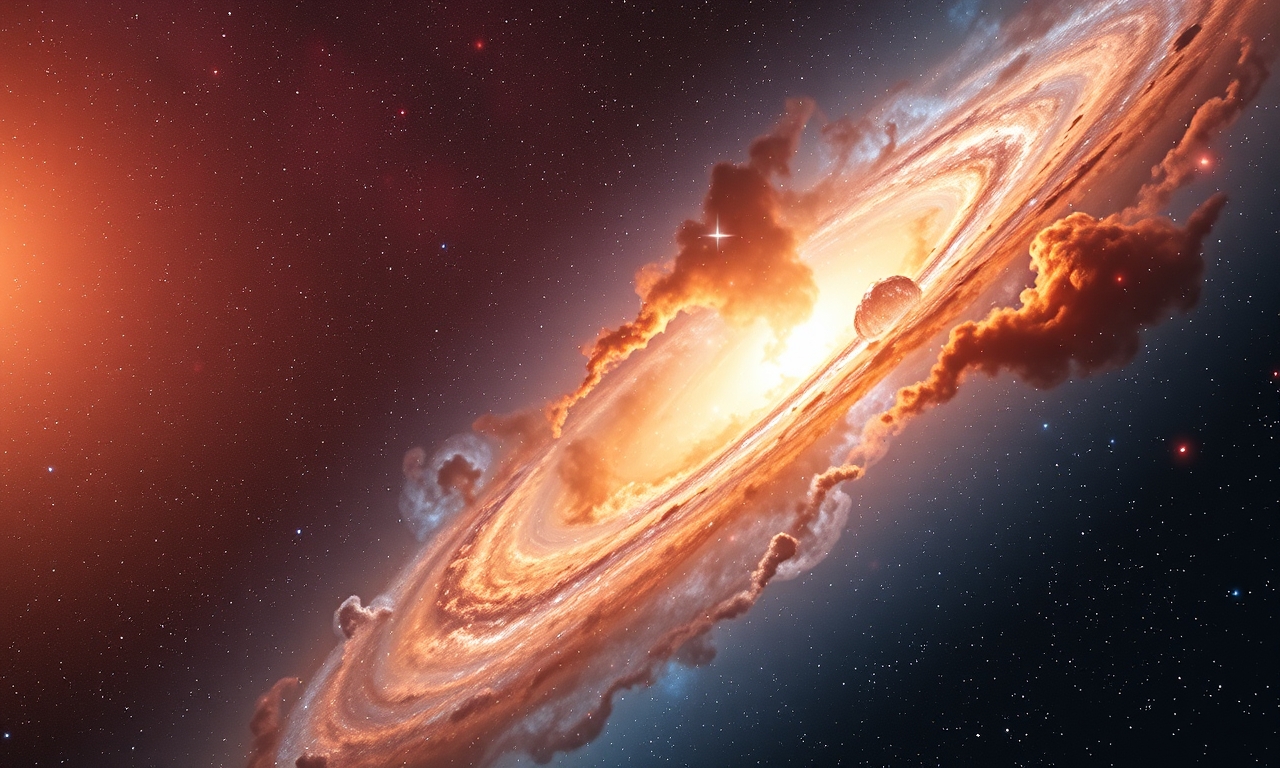
James Webb Space Telescope Reveals Dust Production in Early Galaxies
Using the James Webb Space Telescope, astronomers examined light from galaxies that existed only a few hundred million years after the Big Bang. These early systems are considered major sources of cosmic dust that enriched the young universe with heavy elements.
To decipher the physical processes behind dust formation, researchers compared the observations with data from a nearby, modern galaxy. This analog exhibits similar star‑formation rates but is far more accessible for detailed spectroscopy.
The analysis revealed that the early galaxies produced dust quantities exceeding the expectations of previous models. In particular, the efficiency of carbon and silicon particle condensation in the first stellar generations was higher than assumed.
The findings help refine numerical simulations of the universe’s chemical evolution and explain why detectable dust signatures appear already in very young galaxies.