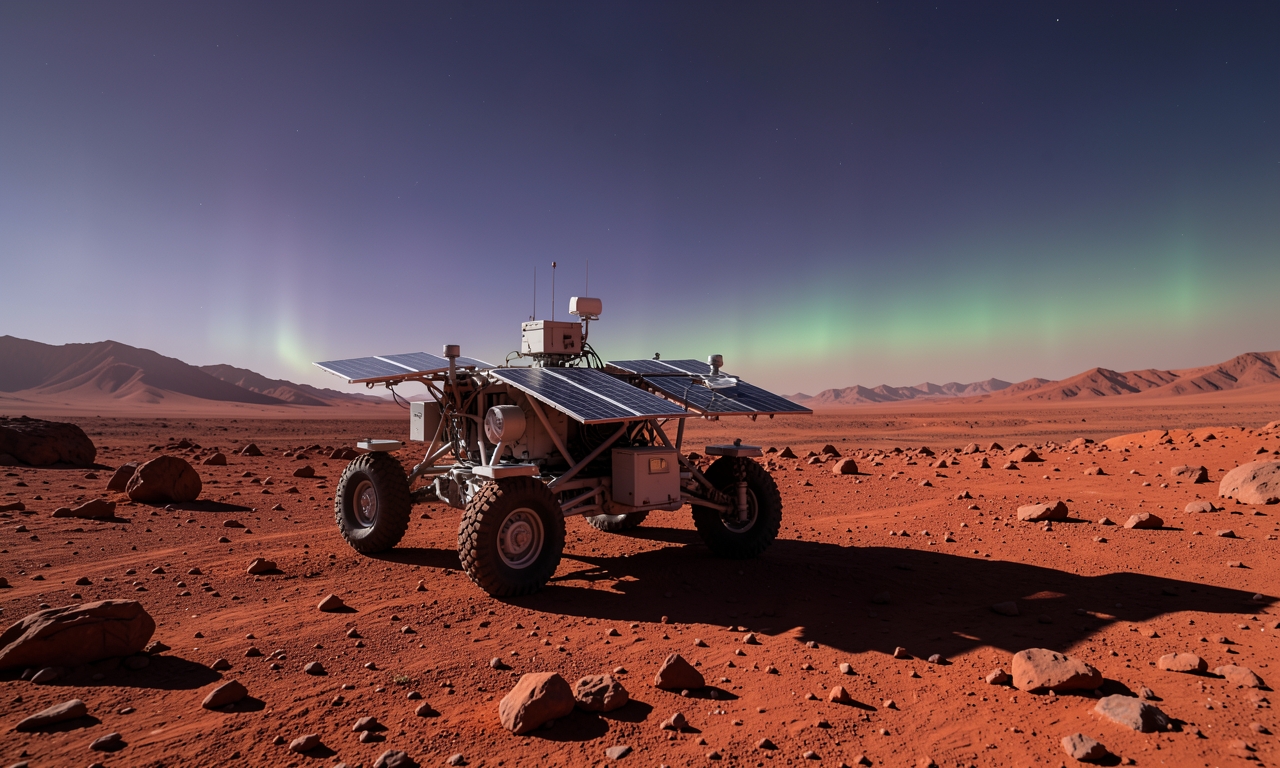
NASA's MAVEN (Mars Atmosphere and Volatile Evolution) spacecraft has been studying the Red Planet's upper atmosphere since its arrival in 2014. Recent analysis has uncovered a key piece of the puzzle explaining how some Martian auroras are generated.
Formation of the lights
The data indicate that the auroral glow occurs when charged particles from the solar wind encounter localized magnetic fields embedded in the Martian crust. These fields guide the particles along field lines, allowing them to penetrate the upper atmosphere and emit light.
Similarities to terrestrial auroras
On Earth, a comparable mechanism takes place: the solar wind interacts with the planet's global magnetosphere, accelerating electrons and ions that travel along magnetic field lines to the polar regions, where they produce the familiar auroral displays. The Martian version follows the same basic physics, albeit on a smaller scale and with a patchy, crust‑based magnetic field.
Implications for science and exploration
Understanding this process improves estimates of atmospheric escape, because the same particle interactions that create auroras can also strip away gases. The insight also aids planners of future missions seeking to characterize the Martian climate, surface environment and potential habitability.