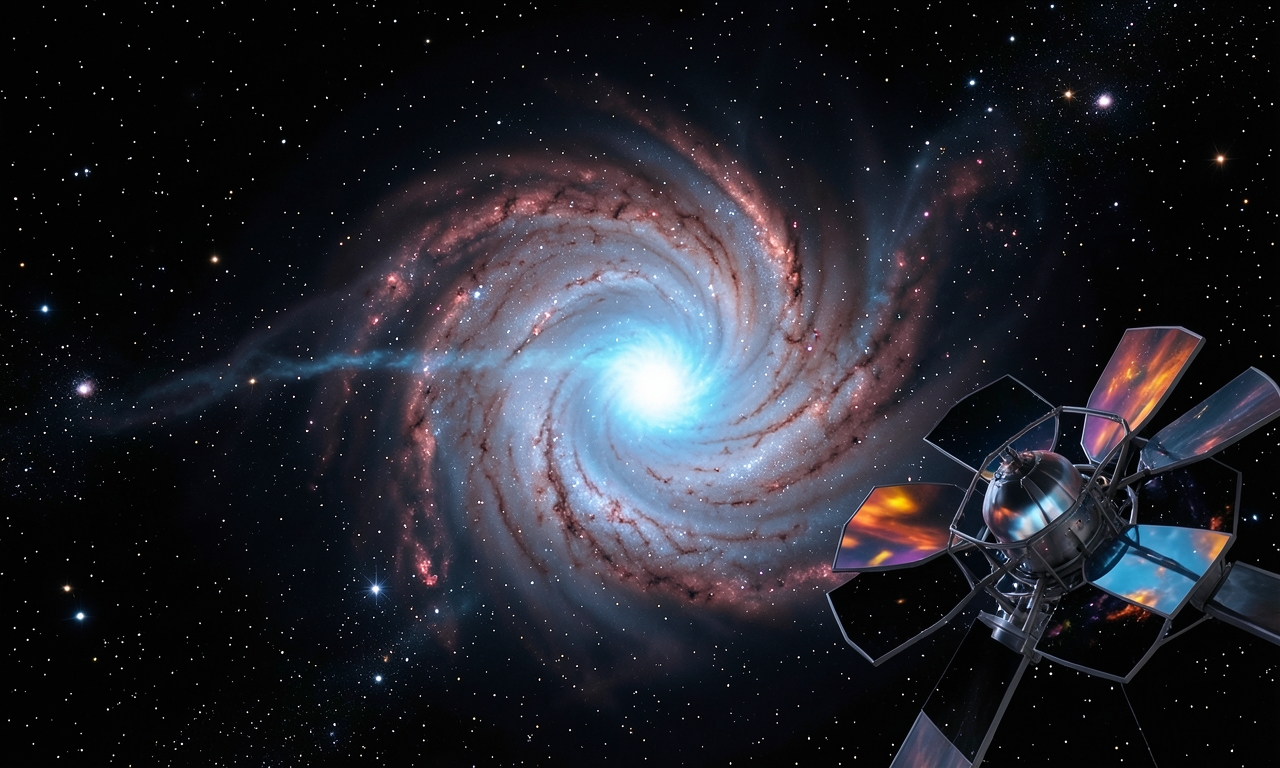
A combined view from two space telescopes
On 20 March 2026 a composite image of the galaxy Messier 64 was released, blending infrared observations from the James Webb Space Telescope (JWST) with ultraviolet, visible and near‑infrared data from the Hubble Space Telescope (HST). Merging the two data sets provides an exceptionally detailed picture that captures the galaxy’s structure over a broad range of wavelengths.
Infrared insights from JWST
JWST observed Messier 64 in the near‑ and mid‑infrared. These wavelengths penetrate dust clouds, revealing cool star‑forming regions and the distribution of molecular gas. The resulting image highlights hidden structures that are invisible in optical light.
UV and visible data from HST
Hubble contributed observations in the ultraviolet, visible and near‑infrared bands, showcasing hot young stars and the bright spiral arms of the galaxy. Combined with the infrared view, the composite presents both the youthful stellar population and the older, cooler components.
Key characteristics of Messier 64
- A prominent dark dust lane gives the galaxy its "Black Eye" nickname.
- Messier 64 is a spiral galaxy with a well‑defined central bulge.
- The joint UV‑infrared analysis provides new clues about the galaxy’s internal star‑formation rate.
The partnership between Hubble and James Webb continues to advance astronomical research by integrating multiple wavelength regimes, delivering a more complete picture of cosmic structures.