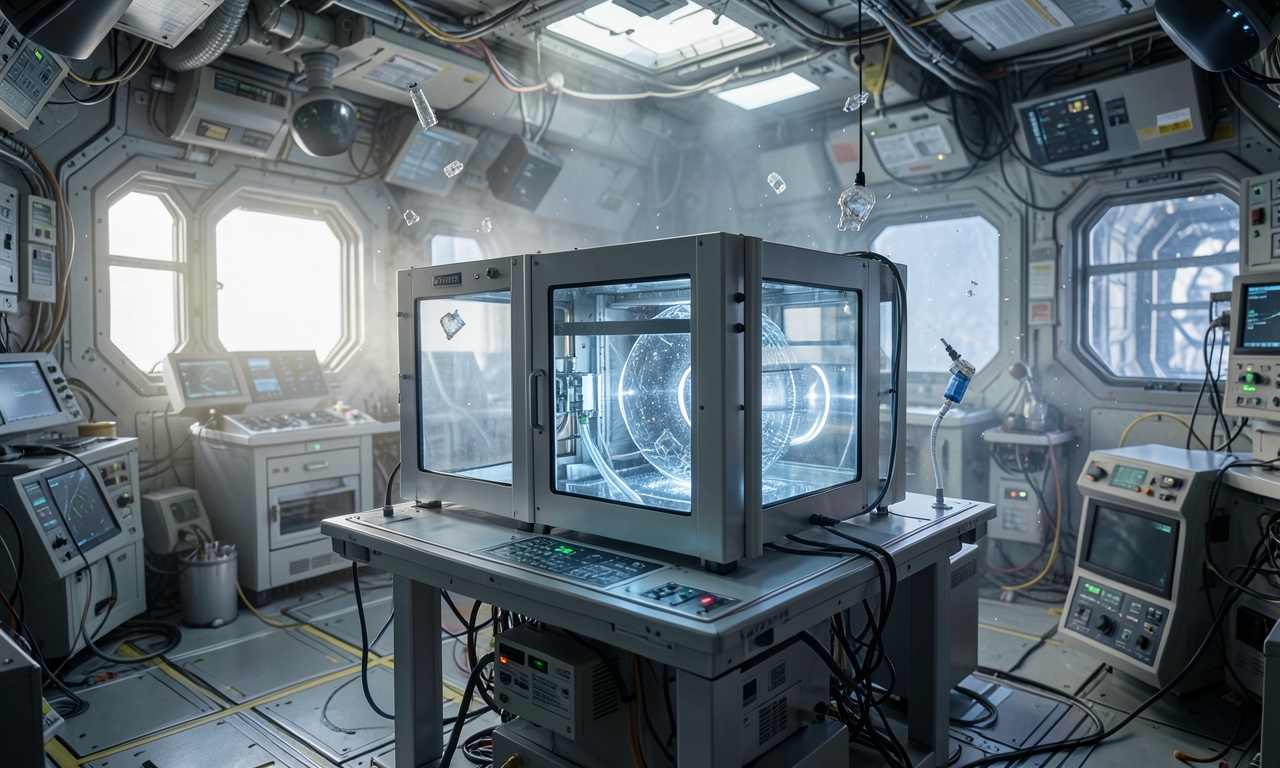
Enhanced cooling for the Cold Atom Lab
Astronauts aboard the International Space Station have powered up the upgraded Cold Atom Lab (CAL), now equipped with a more powerful cryogenic system. The new hardware reaches lower temperatures, facilitating the production of ultracold atoms.
Microgravity on the ISS provides an environment where atoms can be studied with minimal external disturbances. The upgraded system brings the temperature down to a few nanokelvin, a regime that is difficult to achieve on Earth without large, complex facilities.
Scientific objectives
The laboratory is intended to probe the fundamental behavior of matter and lay groundwork for future quantum technologies. Planned experiments include creating Bose‑Einstein condensates, exploring quantum gases, and performing precision measurements relevant to atomic clocks and gravimetric sensors.
Implications for space exploration
Studying quantum phenomena in space opens possibilities for advanced navigation, communication, and sensing. Data gathered may inform the development of ultra‑sensitive instruments for upcoming missions to the Moon, Mars, or asteroids.
Future plans
NASA aims to expand CAL’s capabilities and host additional experiments from international partners. In the long term, the lab is envisioned as a testbed for technologies that could later be deployed on satellites or crewed spacecraft.