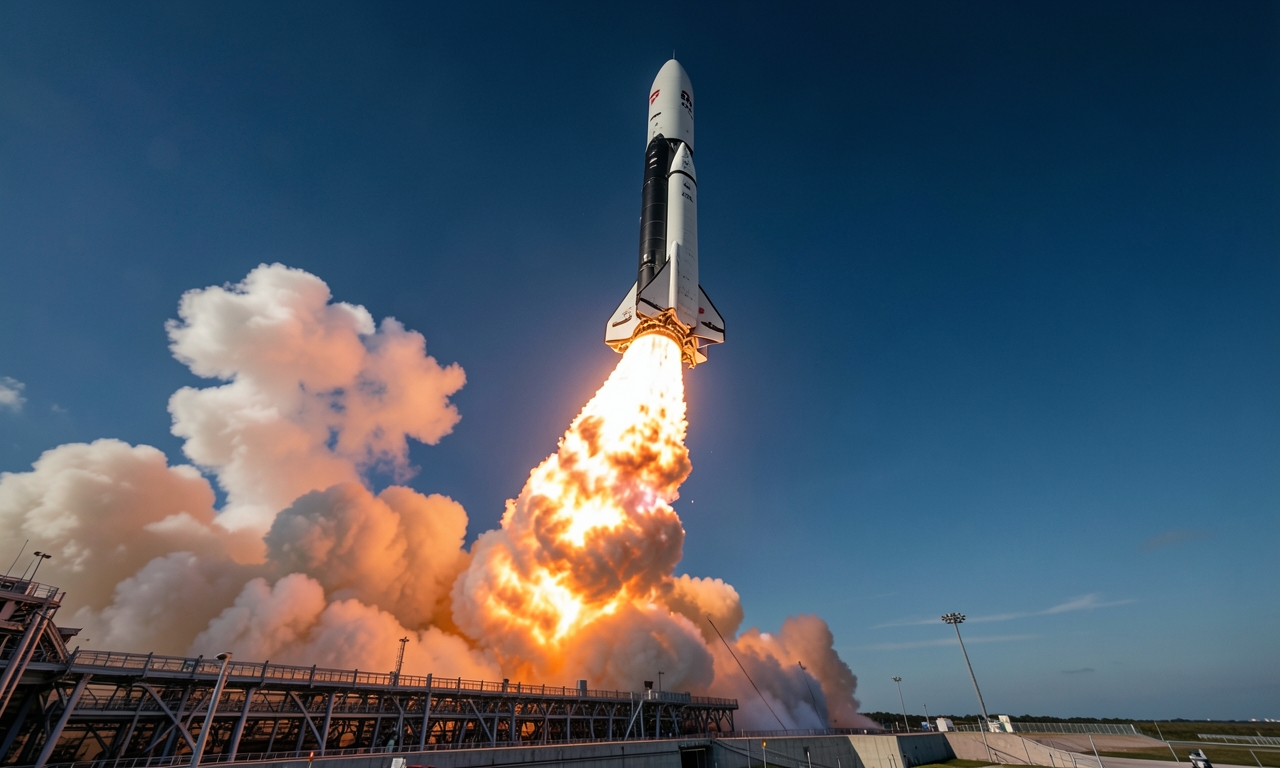
NASA has awarded SpaceX the contract to launch the StarBurst gamma‑ray detector, a small satellite designed to study neutron star mergers and the origins of short gamma‑ray bursts.
The StarBurst spacecraft will ride as part of a Bandwagon rideshare mission aboard a Falcon 9 rocket. Launch is scheduled from Space Launch Complex 40 at Cape Canaveral Space Force Station in Florida.
StarBurst’s primary goal is to detect high‑energy photons emitted during the violent collision of neutron stars, events that also produce gravitational waves observable by ground‑based detectors.
By linking gamma‑ray observations with gravitational‑wave data, scientists hope to better understand the physics of ultra‑dense matter and the synthesis of heavy elements such as gold and platinum.
The mission exemplifies NASA’s strategy of using commercial launch providers to increase access to space for focused scientific payloads while keeping costs low.
SpaceX’s Falcon 9, with its proven track record of rideshare flights, will provide the reliable ascent needed to place StarBurst into its intended low‑Earth orbit.