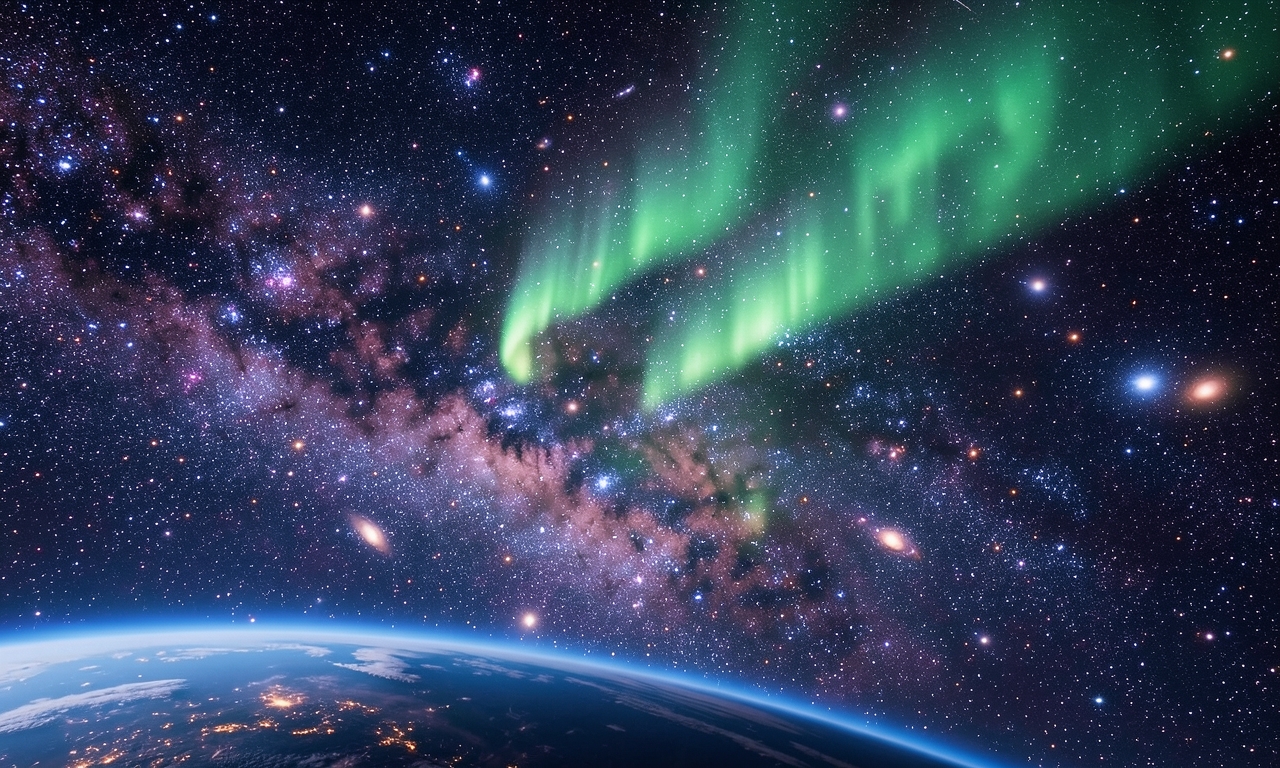
A newly released image taken from orbit showcases an extraordinary natural display: neon‑green auroras shimmering above the high latitudes. The photograph was captured by an orbital platform monitoring Earth's atmosphere from several hundred kilometres altitude.
What creates the vivid hue
The bright green shade results when energetic particles carried by the solar wind collide with oxygen atoms at altitudes of roughly 100–300 km. Under specific conditions the excited atoms emit light at a wavelength of 557.7 nm, which appears as a vivid green to the human eye.
Such intense coloration is uncommon, requiring a combination of strong solar wind, heightened solar activity, and a dense oxygen layer. Current solar activity is near the peak of the 11‑year solar cycle, increasing the likelihood of powerful auroral events.
Orbital perspective
The picture was taken by a camera aboard an international space station that routinely observes the magnetosphere. Viewing from space provides an unobstructed view, free from atmospheric scattering that often dulls colors in ground‑based observations.
Researchers from NASA and ESA intend to analyse the data to improve magnetospheric models and to better understand how solar events influence Earth's climate system.