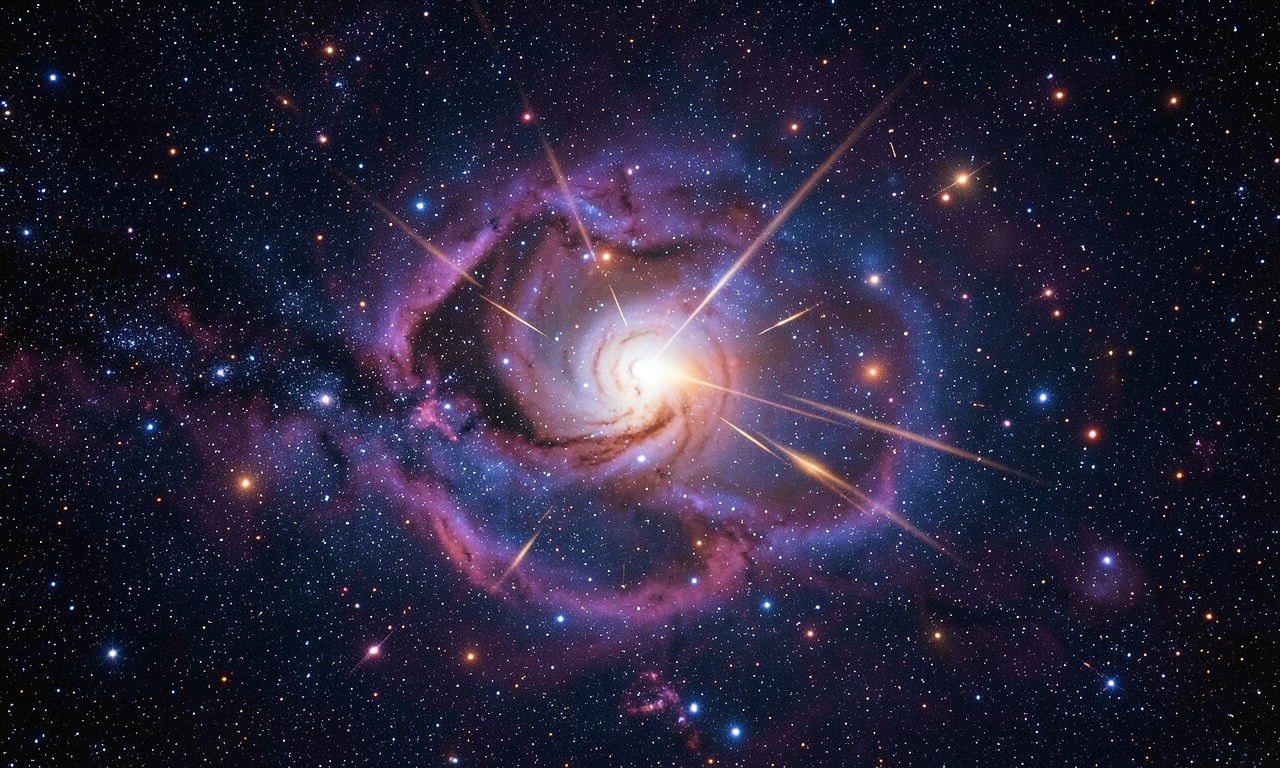
Detection of extreme outflows
An international team of astronomers employed the XMM‑Newton and NuSTAR space observatories to record one of the most energetic ultra‑fast outflows (UFOs) ever observed from a distant supermassive black hole. The object of study is a hyper‑luminous quasar situated at the epoch commonly referred to as cosmic noon.
Two distinct wind components
Spectral analysis revealed the presence of two separate streams of material being expelled at relativistic speeds from the black hole’s vicinity. The components differ in velocity and ionisation state, indicating a complex outflow structure driven by the central engine.
Publication status
The findings were posted as a pre‑print on the arXiv server on 3 June and subsequently submitted to the journal Astronomy & Astrophysics. The manuscript is currently undergoing minor revisions before final acceptance.
Implications for galaxy evolution
Such powerful outflows are thought to influence host‑galaxy evolution by removing gas from the central regions, thereby regulating star formation. The new observations provide valuable empirical constraints for theoretical models of black‑hole feedback.