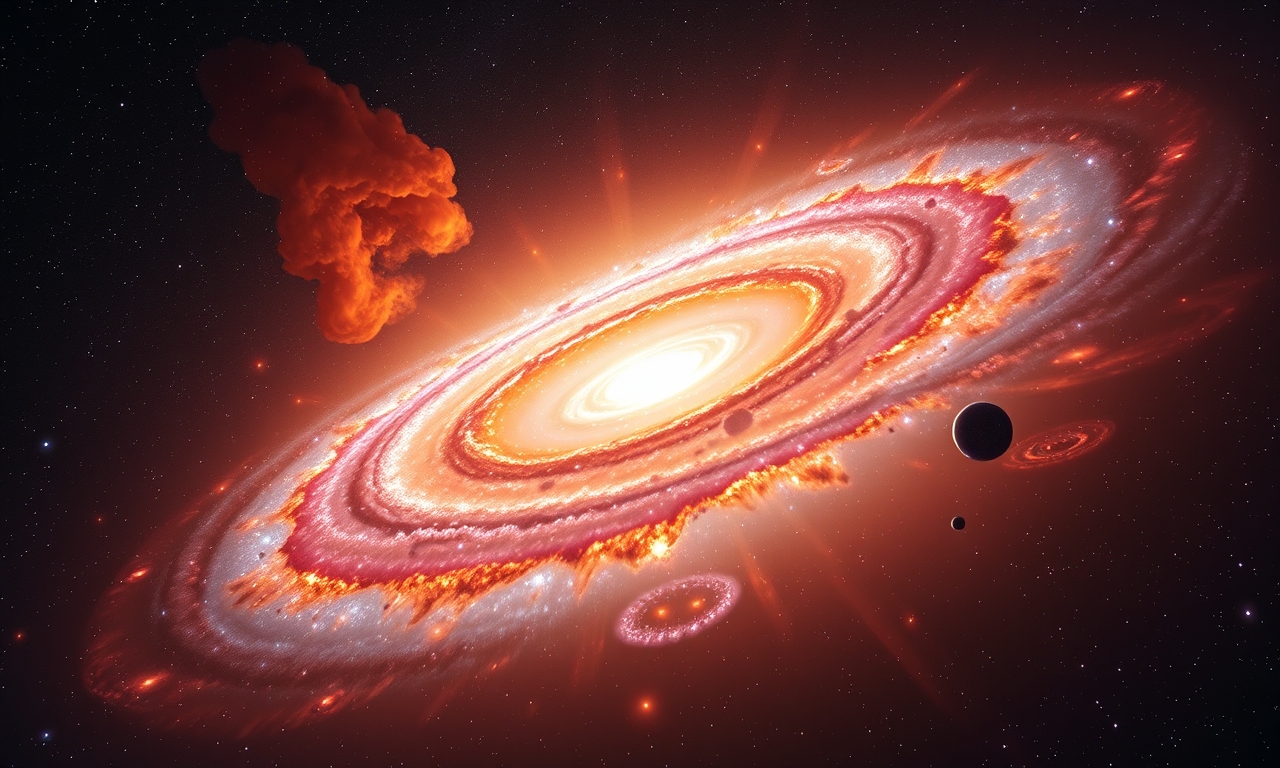
Intense star formation in the Cigar Galaxy
The object known as the Cigar Galaxy, or Messier 82, lies roughly 12 million light‑years from Earth. Observations indicate that it creates stars at a rate about ten times that of our own Milky Way, placing the galaxy in a brief, vigorous phase of its evolution.
James Webb reveals the stellar census
Utilising the high resolution and sensitivity of the James Webb Space Telescope (JWST), astronomers have pierced the dense dust veil surrounding the galaxy’s core. Their analysis identified approximately 16.5 million individual stars within Messier 82, providing crucial data on its total mass and evolutionary state.
Drivers of the extreme starburst
Theoretical models suggest that gravitational interactions with nearby galaxies, especially the adjacent Messier 81, compress the gas in Messier 82. This compression triggers the formation of massive star clusters, fueling the observed star‑burst activity. The presence of abundant interstellar material further sustains the high formation rate.
Future outlook
While the current star‑forming episode is remarkable, it is not expected to persist indefinitely. Rapid consumption of gas reserves will eventually curb the activity, leading the galaxy into a more quiescent stage. Ongoing JWST observations will track this transition and enhance our understanding of starburst mechanisms in galaxies.