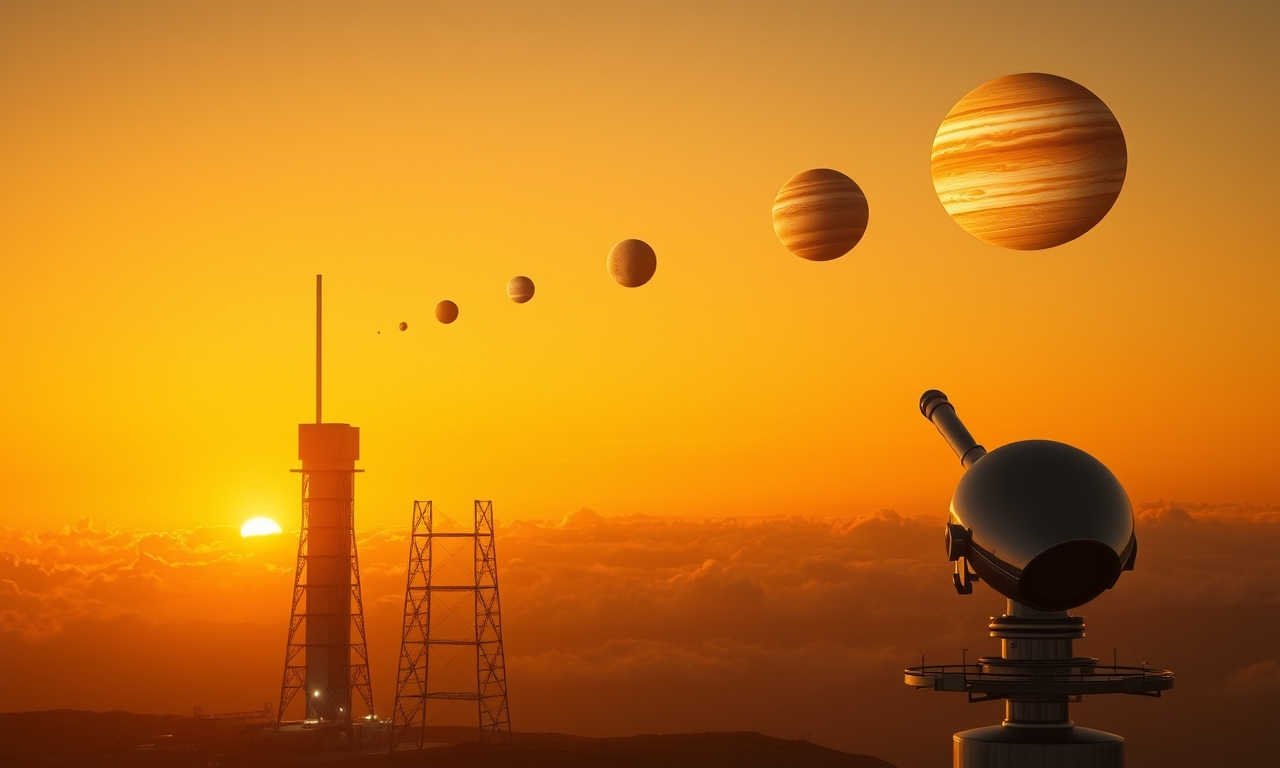
A Brief Glimpse of the Three Planets
Following the sun’s descent on June 12, observers will witness an exceptional alignment: Mercury, Venus, and Jupiter will line up in a narrow band across the western horizon. Although the display lasts only a few minutes, the brightness of the planets promises a memorable sight.
Mercury, the smallest and innermost planet, will appear as the brightest dot, followed by Venus, often called the "evening star." Jupiter, the largest planet, will complete the trio, adding a striking contrast to the luminous Venus.
The visibility of this triple arrangement depends on geographic latitude. In Central Europe the parade is most clearly seen when the sun sets not too low. Optimal viewing conditions are achieved from a location with an unobstructed western horizon and minimal light pollution.
Astronomers use such rare events to verify planetary positions and perform precise measurements of celestial mechanics. For casual observers, the parade offers a chance to see the planets without a telescope and to gauge their relative brightness.
This phenomenon illustrates how planetary motions can create spectacular configurations that continue to captivate even in our modern era.