A Rare Cosmic Encounter
In the outer regions of galaxies, a massive black hole and an isolated star can occasionally cross paths. Such events are extremely rare, occurring on average only once every 100,000 years per galaxy. When they do happen, the black hole’s intense gravity produces dramatic effects on the star.
As the star approaches the black hole’s event horizon, the gravitational pull on the near side becomes significantly stronger than on the far side. This differential force stretches the stellar material—a process known as spaghettification—pulling the star apart into a thin stream of gas.
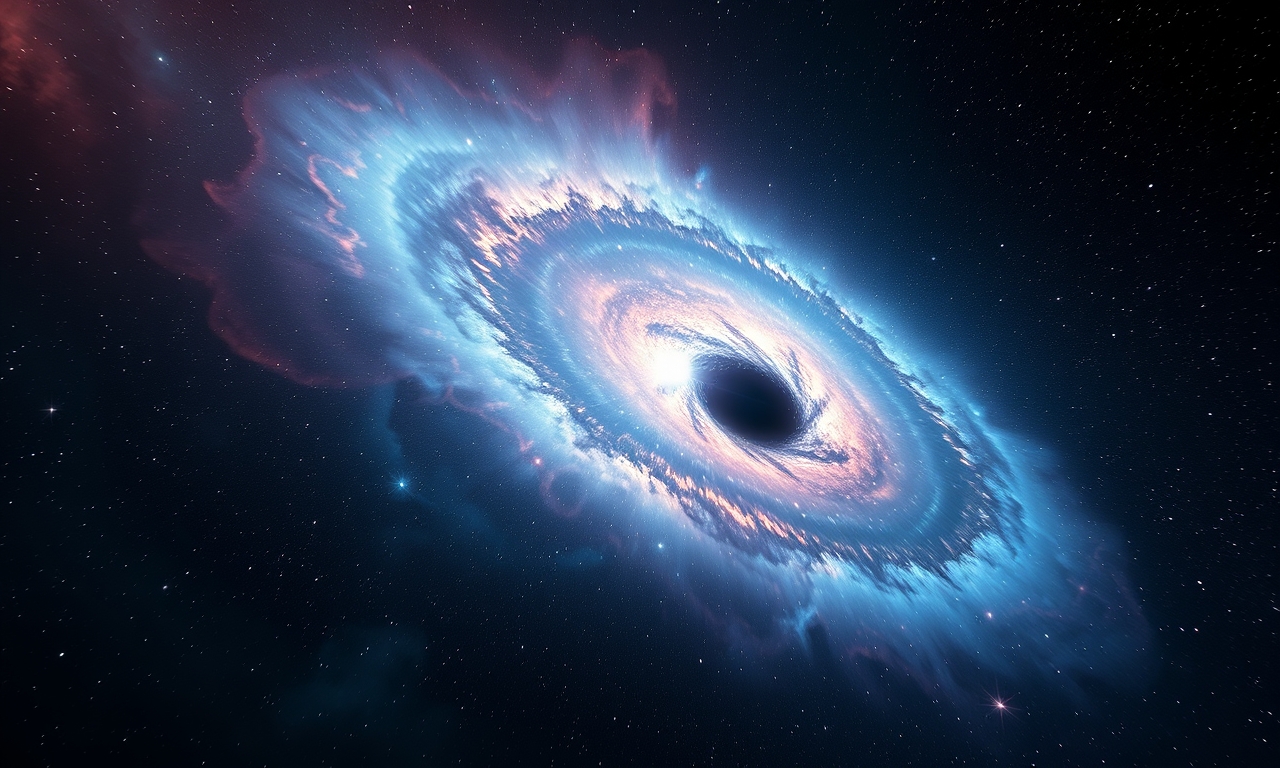
The stripped gas loses angular momentum and settles into a hot accretion disk around the black hole. Within this disk, gravitational potential energy is converted into radiation, which is most readily detected in X‑ray and ultraviolet wavelengths. These flashes allow astronomers to observe otherwise invisible encounters and study their properties.
Observing tidal disruption events provides valuable information about the mass and spin of the involved black hole, as well as details about the disrupted star. Moreover, the data help test models of accretion and the feedback mechanisms between black holes and their galactic environments.
Current space‑based observatories such as XMM‑Newton, NICER and the upcoming Athena mission are designed to catch these short‑lived flares quickly. Rapid follow‑up observations enable scientists to track the evolution of the accretion disk in real time and draw conclusions about the physical processes operating near the event horizon. Such insights are essential for deepening our understanding of extreme gravity.