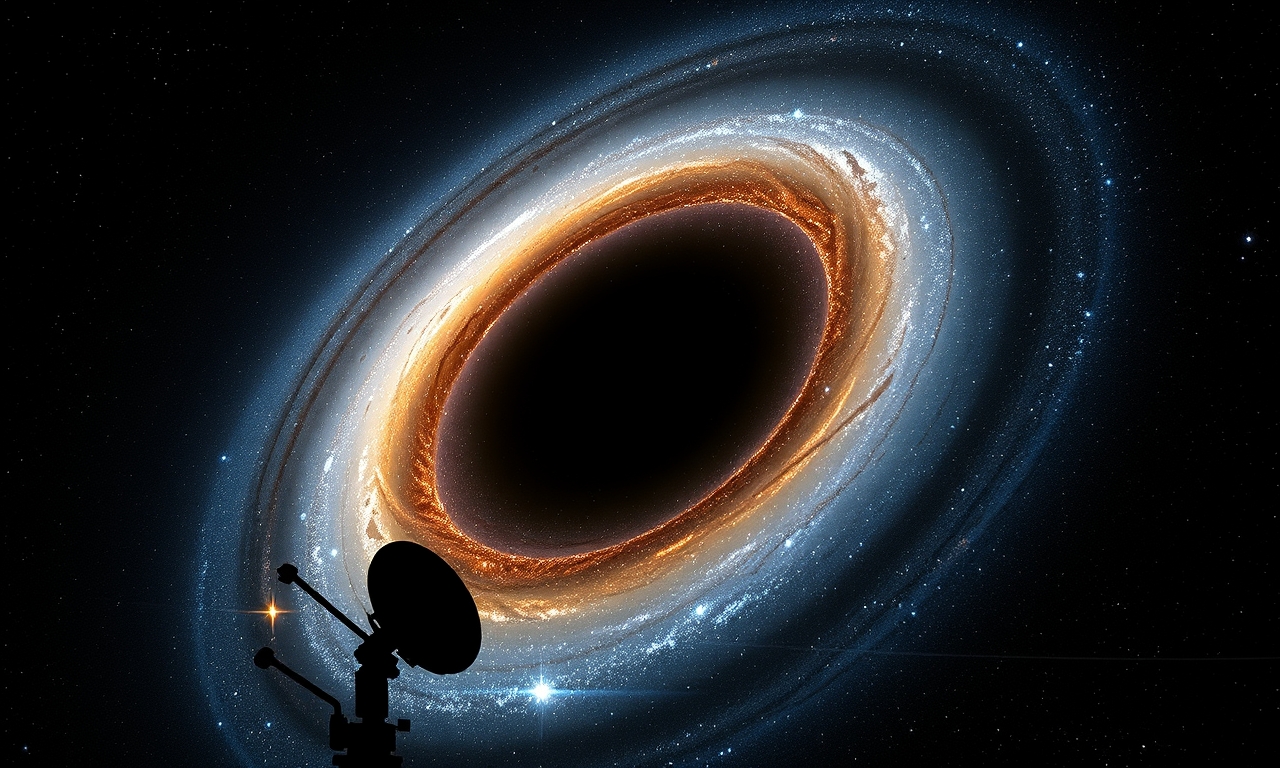
Unique image synthesis
On 20 March 2026 a composite picture of the Black Eye Galaxy (Messier 64) was released, merging observations from two space telescopes. The James Webb Space Telescope (JWST) provides data in the near‑ and mid‑infrared range, while the Hubble Space Telescope (HST) captures the galaxy in ultraviolet, visible and near‑infrared light.
Scientific value
By integrating these wavelength regimes, researchers can examine the galaxy’s structure more comprehensively. JWST’s infrared penetrates dust clouds, exposing star‑forming regions invisible to Hubble’s optical view. Conversely, Hubble’s UV and visible images trace hot, young stars and outline the spiral arms.
Technical specifics
- JWST instruments: NIRCam and MIRI, covering 0.6 µm to 25 µm.
- HST cameras: ACS and WFC3, covering 0.2 µm to 1.6 µm.
- Image composition: precise astrometric alignment of multi‑band data.
Implications for research
Messier 64 is distinguished by a prominent dark dust lane that resembles a “black eye.” The merged image allows astronomers to better model the interaction of gas, dust and stars and offers insights into the dynamics of its central supermassive black hole.
Future observations
The outcome reinforces the strategy of coordinated multi‑telescope campaigns to achieve a fuller picture of cosmic objects. Ongoing monitoring of Messier 64 with both JWST and Hubble is planned to track evolutionary changes over the coming years.