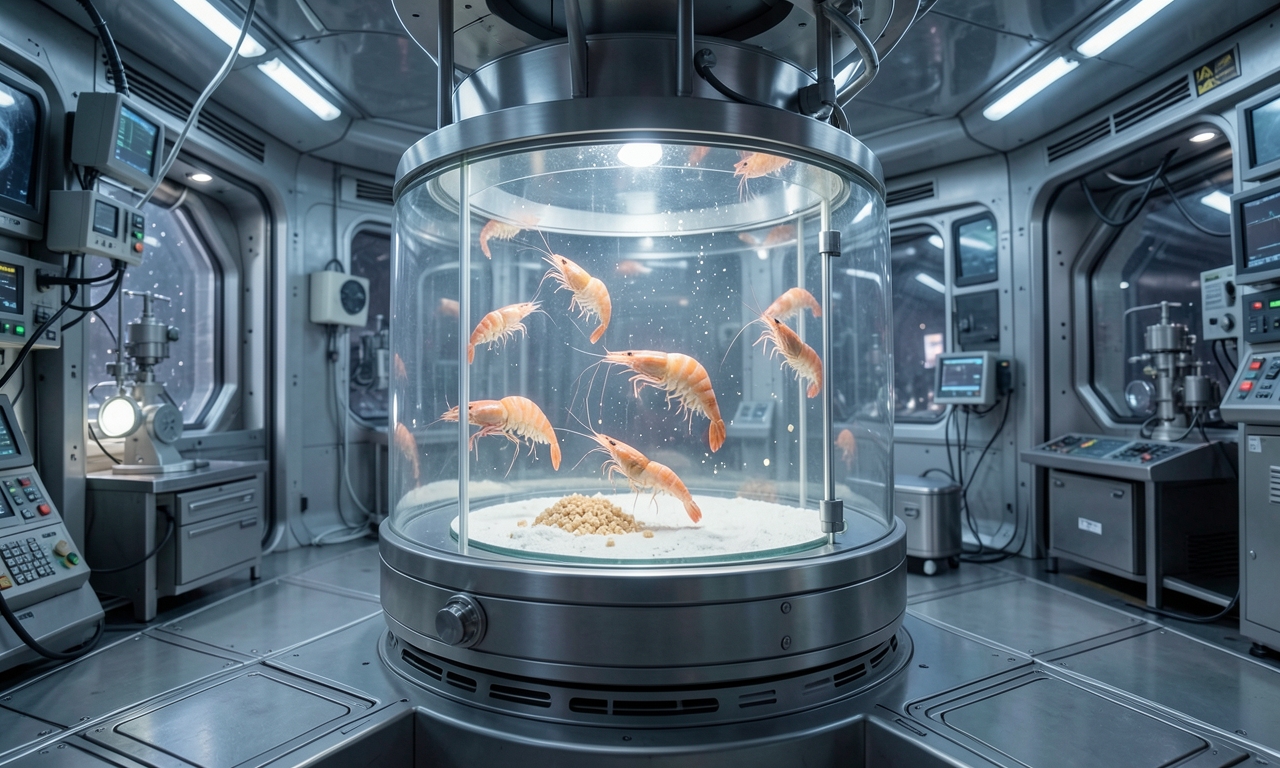
Simulating space conditions in the lab
Because no natural food sources exist in space, all provisions for exploration beyond Earth must be carried along. Although seafood has long been a staple on our planet, little was known about how aquatic species respond to the reduced gravity they would encounter off Earth. A team at Japan's Okayama University of Science has now published a study in Microgravity Science and Technology addressing this gap.
The researchers applied a novel method to reproduce microgravity on the ground. This allowed them to watch crustacean behavior that would otherwise only be expected in actual spaceflight. A central issue was whether and how the animals could consume food under lowered gravitational pull.
Findings point to possible uses
The observations indicated that the tested crustaceans were able to take in nourishment even within the simulated space environment. The authors conclude that such creatures could in principle serve as part of a future food chain supporting long-duration stays away from Earth. This includes planned outposts such as bases on the Moon.
- Okayama University of Science conducted the experiments
- Results published in Microgravity Science and Technology
- Crustaceans fed under simulated microgravity
- Potential for future space nutrition systems
Additional research is required to obtain robust conclusions for real missions. Nevertheless, the present work offers a first basis for including aquatic organisms in plans to supply lunar settlements.