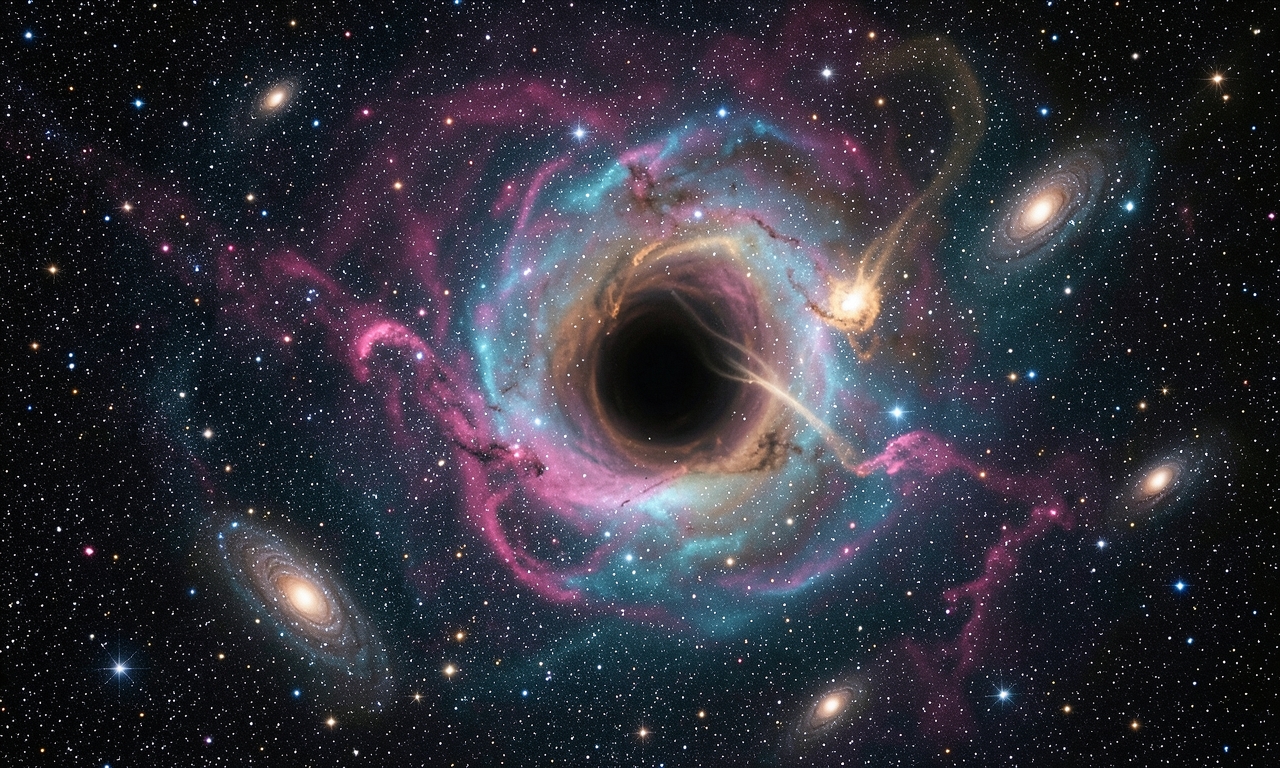
Delayed Radio Emission Following Stellar Disruption
Scientists using the National Science Foundation's Very Large Array have discovered that supermassive black holes continue to be active long after a star is torn apart. After a delay of several years, they eject streams of gas that slam into the ambient interstellar medium, producing bright radio flashes.
How the Late‑time Bursts Arise
The sequence begins with a tidal disruption event, where the black hole's gravity rips a star apart. While the initial flare fades quickly in optical and high‑energy bands, a fraction of the stellar debris remains bound in orbit. Over months to years this material can fall back toward the black hole, forming a jet or outflow that pierces the surrounding gas.
Radio “Burps” as Diagnostic Tools
The Very Large Array detects these events as short, intense radio bursts. When the outflow strikes dense gas, shock waves accelerate particles to relativistic speeds, causing synchrotron radiation observable at radio frequencies.
Implications for Black‑Hole Feedback
These delayed bursts provide a new window on how black holes feed back energy into their host galaxies over extended periods. They demonstrate that feedback is not confined to the immediate aftermath of a tidal disruption but can persist for years, influencing galactic evolution.
Future Prospects
Continued monitoring with the VLA and upcoming radio facilities will aim to quantify the frequency of such delayed bursts and assess their role in the overall energy budget of galaxies.